About Eruca sativa Hill
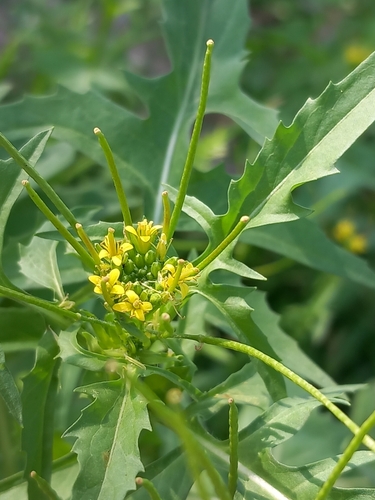
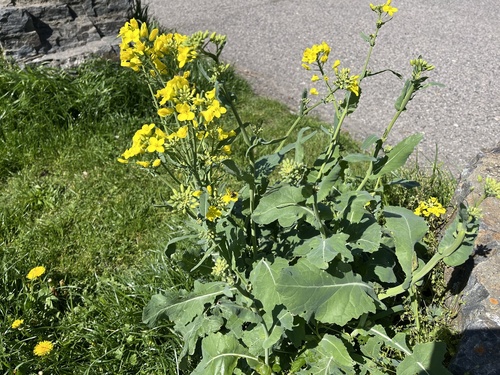
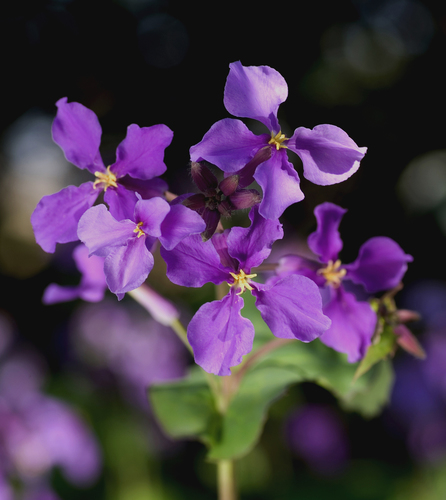
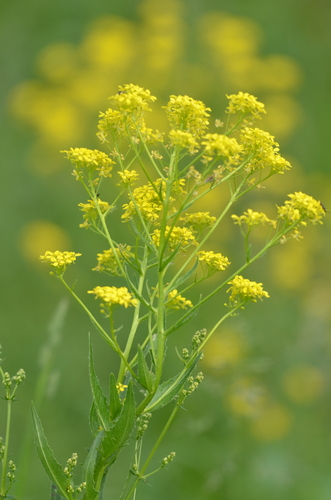
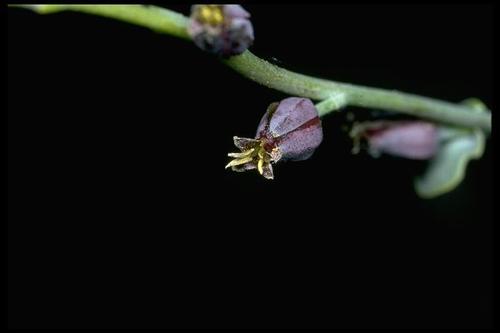
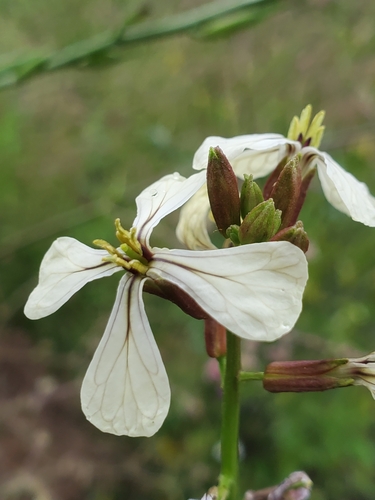
Eruca sativa Hill is an annual plant that reaches 20 to 100 cm (8 to 40 in) in height. Its pinnate leaves are deeply lobed, with four to ten small lateral lobes and one large terminal lobe. Its flowers are 2 to 4 cm (3⁄4 to 1+1⁄2 in) in diameter, arranged in a corymb, and follow the typical flower structure of the Brassicaceae family. The flower petals are creamy white with purple veins, and the stamens are yellow. The fruit is a siliqua (pod) 12 to 25 mm (1⁄2 to 1 in) long, with an apical beak, and holds several seeds inside. This species has a chromosome number of 2n = 22. Eruca sativa is native to areas of the Mediterranean and Asia, including southern Europe, North Africa, and the Middle East. The species most commonly grows on dry, disturbed ground. It serves as a food source for the larvae of some moth species, including the garden carpet. Its roots are vulnerable to infestation by nematodes. As an invasive species, rocket (the common name for this plant) is widespread and scattered, but it grows prolifically and is considered a noxious weed in the Sonora Desert of Arizona and California. Eruca sativa has been cultivated as an edible, popular herb in Italy since Roman times. Ancient Roman authors mentioned it as an aphrodisiac, for example in the poem Moretum, long attributed to the first-century poet Virgil, which includes the line: "et Venerem revocans eruca morantem" ("and the rocket, which revives drowsy Venus [sexual desire]"), and also in Ovid's Ars Amatoria. Some writers claim that because of this reputation as an aphrodisiac, growing rocket was forbidden in monasteries during the Middle Ages. Even so, the plant was included in a decree by Charlemagne, which listed it among 63 pot herbs suitable for growing in gardens. Gillian Riley, author of the Oxford Companion to Italian Food, writes that because of its reputation as a sexual stimulant, it was "prudently mixed with lettuce, which was the opposite" (that is, calming or even soporific). Riley goes on to note that "nowadays rocket is enjoyed innocently in mixed salads, to which it adds a pleasing pungency", though Norman Douglas maintained that "Salad rocket is certainly a stimulant". Traditionally, the plant was collected from the wild or grown in home gardens alongside herbs such as parsley and basil. Today, rocket is grown commercially in many locations, and is sold in supermarkets and farmers markets worldwide. It has also naturalized as a wild plant outside its native range in temperate regions across the globe, including northern Europe and North America. In India, the mature seeds of this plant are called "Gargeer". This is the same name used in Arabic, جِرْجِير (jirjīr), though in Arab countries this name refers to the plant's fresh leaves. Mild frost stops the plant's growth and turns its green leaves red. In warm weather, plants reach full maturity in 40 to 50 days.