About Eriocapitella hupehensis (Lemoine) Christenh. & Byng
Scientific Classification and Growth Form
Eriocapitella hupehensis (Lemoine) Christenh. & Byng is a perennial herbaceous plant with a rhizome-like root structure. It grows in clumps and produces 3 to 5 basal leaves, each with a petiole between 5 cm (2 in) and 35 cm (14 in) long.
Leaf Blade Structure
Its leaf blades are ternate: the central leaflet measures 4 to 10 cm (1.6 to 3.9 in) long and 3 to 10 cm (1.2 to 3.9 in) wide, while lateral leaflets are similar in appearance but smaller than the central leaflet.
Stem Characteristics
The stem grows 30 to 100 cm (12 to 39 in) long, and occasionally reaches up to 120 cm (47 in) long. A whorl of 3 leaves, which are technically bracts, wraps around the stem.
Stem Leaf Morphology
Stem leaves resemble basal leaves but are somewhat smaller.
Inflorescence Structure
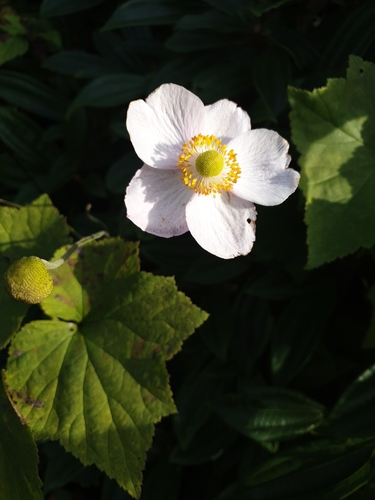
The inflorescence is a cyme with 2 or 3 branches, and its primary flower stalk is 3 to 10 cm (1.2 to 3.9 in) long. Each flower is approximately 5 cm (2.0 in) across.
Flower Sepal Morphology
In native populations, flowers usually have 5 sepals and no petals; cultivated plants often have double flowers with around 20 sepals. Sepal colors include purple, purple-red, pink, or white.
Flower Reproductive Parts
In the center of the flower, there are more than 100 pistils, each 1.5 mm long, surrounded by prominent yellow stamens approximately 5 mm (0.2 in) long.
Fruit Characteristics
Its fruits are small ovoid achenes with straight styles.
Native Distribution Range
Eriocapitella hupehensis is native to Asia, occurring in the Eastern Himalaya, East Asia, and Southeast Asia. Its native range within Eastern Himalaya includes Nepal, Assam in northeast India, and Tibet.
East and Southeast Asia Distribution
In East and Southeast Asia, it is native to China, Taiwan, and Myanmar. In China, it is found in Shaanxi (Northwest China), Hubei (Central China), Jiangxi and Zhejiang (East China), Guangdong and Guangxi (South China), and Guizhou, Sichuan, and Yunnan (Southwest China).
Introduced Distribution
The species has been introduced to Czechoslovakia, Ecuador, and Germany.
Taxonomic Grouping
Along with four other taxa — Eriocapitella × hybrida, E. japonica, E. tomentosa, and E. vitifolia — E. hupehensis is classified as a fall-blooming anemone.
Flowering Period
In its native habitat, it flowers from July to October.
Cultivation Status
Eriocapitella hupehensis and its cultivars are cultivated worldwide, with established naturalized populations especially in Asia, Europe, and South America. In China, this species has been cultivated since at least the 17th century, and cultivation likely dates back to the Tang dynasty (618–907).
Escaped Cultivation History
Hundreds of years ago, a semi-double form of E. hupehensis escaped cultivation and spread across China to Japan and Korea. This escaped descendant, now classified as E. japonica, is a parent of the artificial hybrid E. × hybrida.
Cultivar Trial Research
At the Chicago Botanic Garden, researcher Rudy tested 26 cultivars of fall-blooming anemones over a 5-year period starting in 1998, which included three cultivars of E. hupehensis.
Horticultural Awards
As of March 2020, two E. hupehensis cultivars hold the Award of Garden Merit (AGM) from the Royal Horticultural Society: 'Bowles's Pink' and 'Hadspen Abundance'.