About Actaea elata (Nutt.) Prantl
Growth Form
Actaea elata (Nutt.) Prantl is a rhizomatous herbaceous perennial plant that grows to a maximum height of around 1.8 meters. Its entire structure is hairy, including some glandular hairs.
Leaf Characteristics
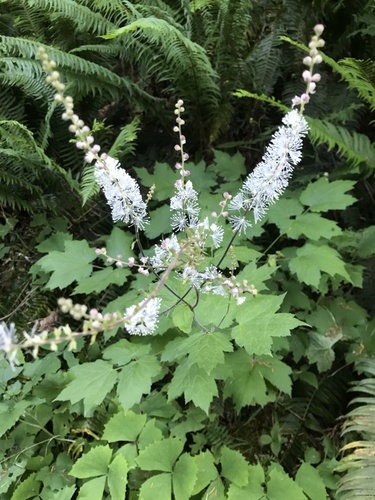
Its leaves are composed of multiple lobed, toothed leaflets that are shaped like maple leaves.
Inflorescence Structure
The plant’s inflorescence is a branching panicle that can reach up to 17 centimeters in length, holding many individual flowers. Each flower has five white or pink-tinged sepals, and no petals, with a prominent cluster of long white stamens.
Blooming Period
Its blooming period runs from May or June through August.
Fruit Characteristics
It produces flattened follicle fruits that grow up to 1.2 centimeters long; these fruits are poisonous. The plant gives off an unpleasant scent.
General Habitat
This species grows in moist woodland and forest habitats. It is mostly limited to lower elevations, and is more commonly found on north-facing slopes.
Associated Forest Trees
It is typically found growing alongside forest trees including Douglas fir (Pseudotsuga menziesii), bigleaf maple (Acer macrophyllum), western redcedar (Thuja plicata), red alder (Alnus rubra), and vine maple (Acer circinatum), as well as other forest understory plants such as oceanspray (Holodiscus discolor), hazelnut (Corylus cornuta), sword fern (Polystichum munitum), and snowberry (Symphoricarpos albus).
Indicator Species
Alpine enchanter's nightshade (Circaea alpina), herb robert (Geranium robertianum), and wall lettuce (Lactuca muralis) are indicator species that often grow alongside Actaea elata. Where the species is common, it can become the dominant plant in the forest understory.
Light Requirements
It may occur in old-growth forests, and prefers the shaded conditions of dense forests. It can tolerate some small gaps in the forest canopy, but cannot withstand large-scale clearing such as clearcutting. A small amount of sunlight penetration during its reproductive season is beneficial to the plant.
Associated Fauna
Mountain beaver (Aplodontia rufa) are associated with this species, particularly in Canadian populations. Depending on the location, pollinators that visit this plant include bumblebees, other bee species, beetles, and syrphid flies.
Distribution Range
This species has a restricted overall distribution. Most of its known populations are located in southern Oregon, where populations can be large. There are far fewer known occurrences in Washington.
British Columbia Status
In British Columbia, the plant is only recorded from the far southern part of the province, near the Chilliwack River, and it is classified as an endangered species in this province. There are only ten known populations in British Columbia, which make up less than 5% of the plant’s total global population.
New Variety Description
In 2004, a new variety of this species, var. alpestris, was formally named and described. This variety is endemic to southern Oregon; it differs from other variants of the species by having scales along its lower stem, and often produces more pistils. It may also occur at higher elevations than the main type.
Threats
Threats to Actaea elata include processes that damage its native forest ecosystems, particularly the old-growth forests of the Pacific Northwest. Fire suppression, logging, road maintenance, other forms of forest disturbance, wild collection of the plant, and harm to pollinator populations all threaten existing populations of the plant.