About Erethizon dorsatus (Linnaeus, 1758)
Common Name and Base Coloration
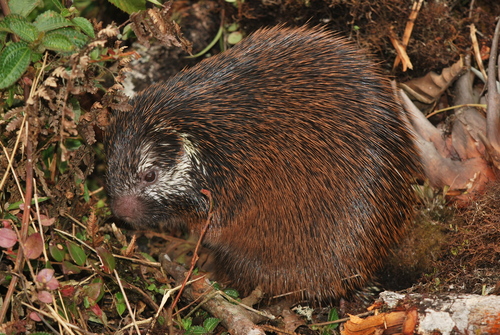
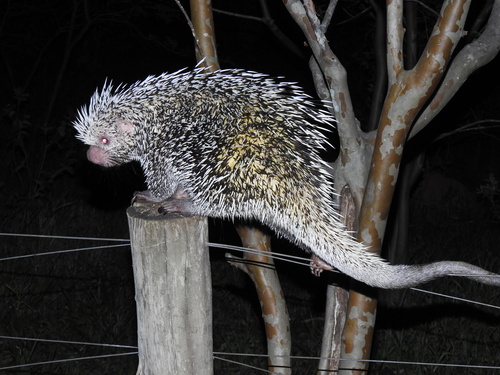
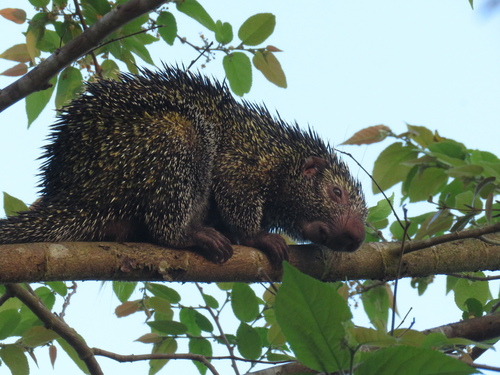
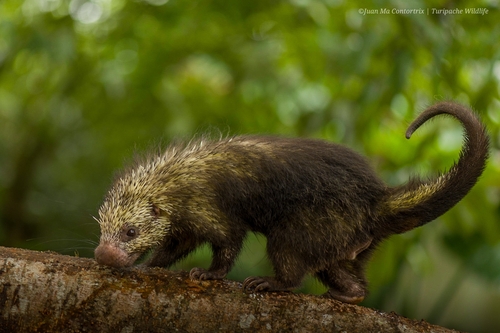
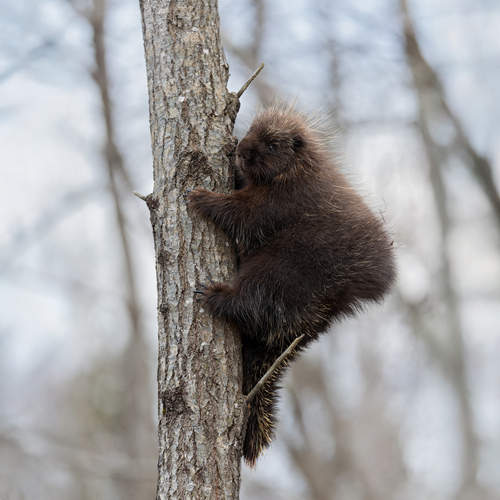
Erethizon dorsatus, commonly called the North American porcupine, is usually dark brown or black with white highlights.
Body Structure
It has a stocky body, small face, short legs, and a short, thick tail.
Size Ranking Among Rodents
This species is the largest New World porcupine, and the second largest rodent in North America, behind only the American beaver.
Head and Body Length
Its head-and-body length measures 60 to 90 cm (2.0 to 3.0 ft), not including its tail, which ranges from 14.5 to 30 cm (5.7 to 11.8 in) long.
Hind Foot Length
Hind foot length is 7.5 to 9.1 cm (3.0 to 3.6 in).
Body Weight
Overall body weight can range from 3.5 to 18 kg (7.7 to 39.7 lb); adult females average around 7 kg (15 lb), while a sample of 5 wild-caught adult males averaged 10.67 kg (23.5 lb).
Aposematic Coloration Context
Along with wolverines and skunks, North American porcupines are North American mammals that have strongly contrasting black-and-white coloration.
Color Pattern Function
This color pattern works as a warning that lets other animals identify them and detect their location in low-light nighttime conditions.
Typical Color Consistency
The overall coloration of Erethizon dorsatum generally does not vary across individuals.
Yellow Quill Subspecies
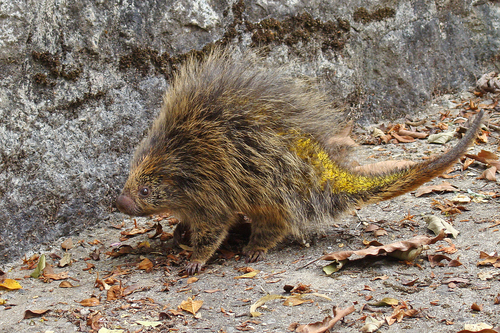
However, in the Pacific Northwest, individuals of the subspecies E. d. epixanthum have been found with distinct yellow-colored quills.
Yellow Quill Cause
These yellow-colored individuals do not have albinism, as their eyes and nose retain their typical pigmentation, so their unusual color is believed to be isabelline.
Eastern Distribution
In eastern North America, the species ranges from Canada south to the Appalachian Mountains in West Virginia and Maryland; east of the Appalachians, their range extends no further south than northern New Jersey.
Western Distribution
In western North America, their range stretches from Alaska south to the northern mountains of Mexico.
Habitat Types
They are most commonly found in coniferous and mixed forested areas, but have adapted to live in harsher environments including shrublands and tundra.
Denning Sites
They make their dens in hollow trees or rocky outcrops and areas.
Female Social Structure
For most of the year, female North American porcupines are solitary.
Breeding Season Timing
This changes in the fall, when breeding season begins.
Female Attractant During Breeding
During breeding season, females secrete thick mucus that mixes with their urine, creating an odor that attracts nearby males.
Male Pre-Mating Perching Behavior
The male typically perches in a tree below the female.
Male-Male Competition
If another male approaches the pair, the two males may fight to win mating rights.
Estrus Trigger
Once a dominant male defeats competitors, he approaches the female and sprays her with urine, which triggers her to enter estrus.
Mating Mechanics
The pair then mates on the ground; during mating, both individuals tighten their skin and hold their quills flat against their body to avoid accidental injury.
Mating Frequency and Conclusion
Mating may repeat multiple times until the female loses interest and climbs back up into the tree.
Gestation Period Length
Relative to other rodents, the North American porcupine has a long gestation period, averaging 202 days.
Gestation Period Comparison
For comparison, the similarly sized American beaver has a gestation period of 128 days, and the much smaller eastern grey squirrel (Sciurus carolinensis) has a gestation period of only 44 days.
Litter Size
North American porcupines give birth to a single young, called a porcupette.
Newborn Weight
At birth, a porcupette weighs about 450 g, and its weight increases to nearly 1 kg within the first two weeks.
Adult Weight Development
Porcupettes do not reach full adult weight until the end of their second summer, when they reach roughly 4.5 kg.
Quill Hardening Timeline
A porcupette's quills harden shortly after birth.
Parental Care Provider
Female porcupines provide all parental care for their young.
Early Offspring Dependence
For the first two weeks, porcupettes rely entirely on their mother for food.
Offspring Foraging Development
After this period, young porcupines learn to climb trees and begin foraging on their own.
Nursing Period Duration
They continue to nurse for up to four months, which aligns with the timing of the fall mating season.
Offspring Dispersal Timing
Porcupettes typically separate from their mother in the fall.