About Eremophila maculata (Ker Gawl.) F.Muell.
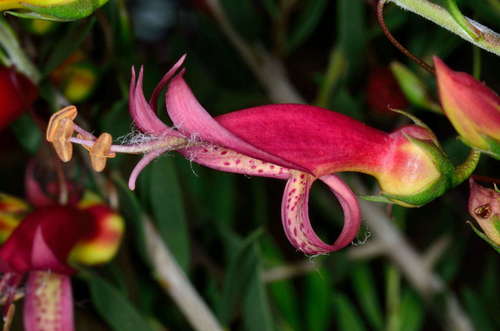
Eremophila maculata is a low spreading shrub that usually grows to less than 2.5 metres (8 ft) tall. Its leaves are between 3.8 millimetres (0.1 in) to 45 millimetres (2 in) long and 0.5–18 millimetres (0.02–0.7 in) wide, and range in shape from almost thread-like to almost circular. Leaves are nearly always glabrous, and never have teeth or serrations on their edges. Flower colour often varies even within a single population, and may be pink, mauve, red, orange or yellow, often spotted on the inside. Flowers grow singly in leaf axils, and have a glabrous, S-shaped stalk 10–25 millimetres (0.4–1 in) long. There are 5 sepals, which are egg-shaped but end in a sudden point, and are green or purplish-green. The 5 petals are joined for most of their length, forming a tube 25–35 millimetres (0.98–1.4 in) long, but the lobes on the sides and bottom of the flower are often turned or rolled back. The outside of the petals is glabrous, but the inside surface of the tube is hairy, and the lobes have a few spider-web like hairs. There are 4 stamens which extend beyond the petals. Flowers may appear in almost any month, but are most prolific in winter and spring. The fruits that develop after flowering are dry, almost spherical, and have an obvious beak. Eremophila maculata occurs in Western Australia, South Australia, Northern Territory, Queensland, New South Wales and Victoria. It often grows on river flats and in areas that experience periodic flooding. According to Joseph Maiden's 1889 book 'The Useful Native Plants of Australia', Eremophila maculata is considered poisonous by some people, and a good fodder bush by others. It does not appear to be dangerous to livestock that are accustomed to eating it, but Hutchinson of Warrego, Queensland considered it deadly to other animals, particularly travelling stock. The harmful effects of this plant are always worse after rain, and it appears to be most dangerous when it is producing fruit, as recorded by Bailey and Gordon. Eremophila maculata is well known in horticulture, and hybrid forms and cultivars such as 'Carmine Star' and 'Aurea' have been developed. The most common form grown in gardens is the cherry-coloured form of E. maculata subsp. brevifolia, but other colours are becoming more popular. It is easily propagated; firm tip cuttings taken during warmer months root the most easily. In its natural habitat, spotted emu bush often grows in heavy clay soil, and it can be grown in similar soil in gardens, or even in deep sand. A sunny position sheltered from strong wind is ideal for this shrub, but it is very drought and frost hardy, and can be grown in coastal areas that sometimes experience high humidity. It is recommended for gardens in the hotter, drier areas of the United States such as Arizona and New Mexico.