About Eremophila longifolia (R.Br.) F.Muell.
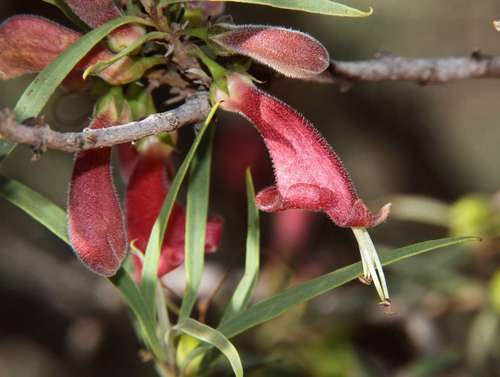
Eremophila longifolia (R.Br.) F.Muell. is a shrub or small tree that grows between 1 and 8 metres (3 and 30 feet) in height. It often produces suckers, so dense stands of cloned individual plants are common. Its branches are usually covered in fine hairs that range in colour from yellow to reddish brown. The leaves are arranged alternately along the branches; they are linear to lance-shaped, often curved like a sickle, and frequently have a hooked tip. Most leaves are 50–160 mm (2–6 in) long and 3–8 mm (0.1–0.3 in) wide, taper towards both ends, and have a prominent mid-vein on their lower surface.
Flowers grow in groups of up to 5 in leaf axils, on stalks that are mostly 4–8 mm (0.2–0.3 in) long. There are 5 green, egg-shaped, tapering, hairy sepals, which are usually 2–7 mm (0.08–0.3 in) long. The petals are 20–30 mm (0.8–1 in) long in most cases, and are joined at their lower end to form a tube. The petal tube ranges in colour from brick-red to pink, and is sometimes marked with darker red spots on the inside. Both the inner and outer surfaces of the tube are covered in hairs, with denser hair growth on the outside. The four stamens extend past the end of the petal tube.
Flowering occurs at different times across different regions of Australia. In Western Australia, flowering mainly takes place between March and November; in southern Queensland it occurs during spring and summer; but in the Riverina area of New South Wales, there is no distinct flowering season. In most areas, flowers can appear in any season depending on rainfall. After flowering, the plant produces fruits that are oval to almost spherical, 5–12 mm (0.2–0.5 in) long. The fruits start yellow, then turn brown, and finally turn black.
Also known as berrigan, this is the most widespread eremophila species in Australia. It can grow in a wide range of soil types and habitats, with the exception of the more humid areas of the east coast. It generally grows in Acacia or Eucalyptus woodland, and is also common on rocky hills, sand plains and sand dunes.
Honeyeaters, emus (Dromaius novaehollandiae) and Australian bustards (Ardeotis australis) are known to feed on this eremophila species.
Eremophila longifolia is one of the most important plant species for Aboriginal Australian people, particularly for those living in Central Australia. It was used in initiation ceremonies, to line graves, for tanning water bags, and was placed in the headbands of warriors. It also had medicinal uses: it was used to treat colds and headaches, and to cleanse and strengthen newborn babies. Compounds found in Eremophila longifolia have been shown to be effective against the bacteria that cause tooth decay.