About Eremophila latrobei F.Muell.
Species Naming and Growth Habit
Eremophila latrobei F.Muell. is usually an erect, many-branched shrub, though it may sometimes be straggly or spindly.
Height
It typically grows between 0.5 and 4 metres (2 to 10 feet) in height.
Branch Characteristics
Its branches are rough due to persistent leaf bases, and are usually glabrous except when they are immature.
Leaf Arrangement and Shape
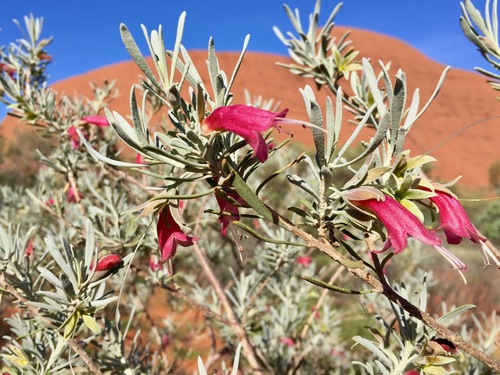
Leaves are arranged alternately along the branches, and vary in shape from thread-like to lance-shaped with the narrower end toward the base.
Leaf Size and Dimensions
They also range from needle-shaped to flat, and are mostly 9 to 50 millimetres (0.4 to 2 inches) long and 0.7 to 3.5 millimetres (0.03 to 0.1 inches) wide.
Flower Stalk Characteristics
Flowers are usually borne singly in leaf axils, on a hairy, curved stalk that is 5 to 11 millimetres (0.2 to 0.4 inches) long.
Sepal Characteristics
There are 5 lance-shaped, green or purple sepals with hairy edges; sepals are mostly 10 to 19 millimetres (0.4 to 0.7 inches) long, and increase in size after flowering.
Petal Structure
Petals are mostly 20 to 32 millimetres (0.8 to 1 inch) long, and are joined at their lower end to form a tube.
Petal Coloration
The petal tube is red to purple-red, and rarely yellow or cream-coloured.
Petal Hair Coverage
Scattered glandular hairs cover the inside and outside of the tube and the petal lobes.
Stamen Characteristics
The four stamens extend beyond the end of the petal tube.
Flowering Period
Flowering occurs mainly from March to October, and is followed by fruits.
Fruit Characteristics
The fruits are dry, woody, oval-shaped to conical, and hairy; they are 6.5 to 8 millimetres (0.26 to 0.31 inches) long, with a papery, sometimes sticky covering.
Subspecies General Distribution
For distribution and habitat, subspecies latrobei and glabra are widespread, occurring in Western Australia, the Northern Territory, South Australia, Queensland and New South Wales.
Subspecies glabra New South Wales Range
In New South Wales, subspecies glabra is only found in the far north-west corner of the state, near Tibooburra.
Subspecies Habitat Preferences
Both subspecies grow in a wide range of habitats and vegetation associations; subsp. latrobei favours mulga and mallee woodland, while subsp. glabra prefers sand plain.
Subspecies filiformis Distribution
Subspecies filiformis is mainly found in the Hamersley Range, though isolated populations occur in the Central Ranges, Gibson Desert, Little Sandy Desert, Murchison, Ord Victoria Plain, Pilbara and Tanami biogeographic regions.
Common Name and Cultivation Status
Commonly called crimson turkey bush, this species is well known in cultivation.
Garden Use
It is a variable species, so growing several forms together can add variety to a garden, as well as attract nectar-feeding birds.
Propagation and Water Requirements
It can be propagated from cuttings or by grafting onto Myoporum rootstock, and only needs occasional watering.
Frost Tolerance
Its frost tolerance depends on the form grown, so it is best grown in a frost-free area.
Light and Humidity Requirements
It will grow in more humid areas, but requires full sun.