About Eremophila debilis (Andrews) Chinnock
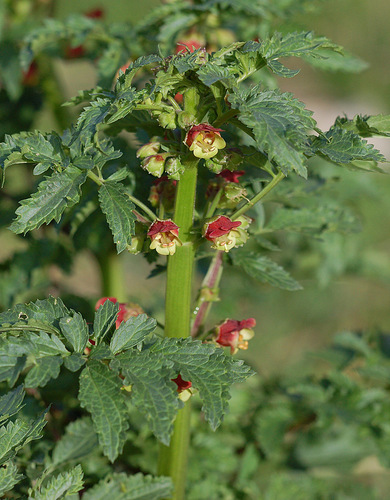
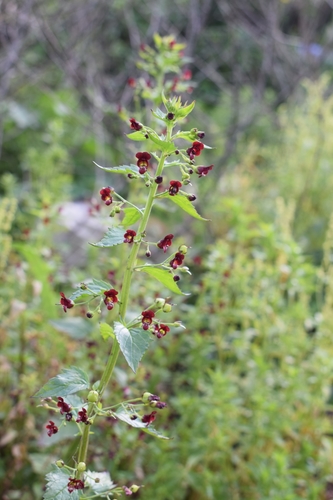
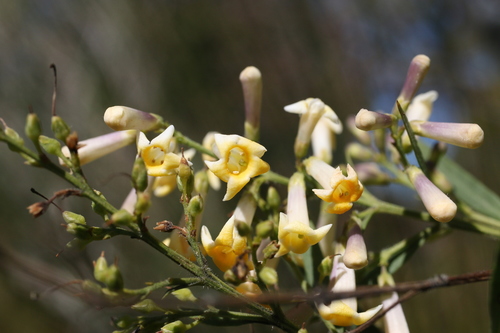
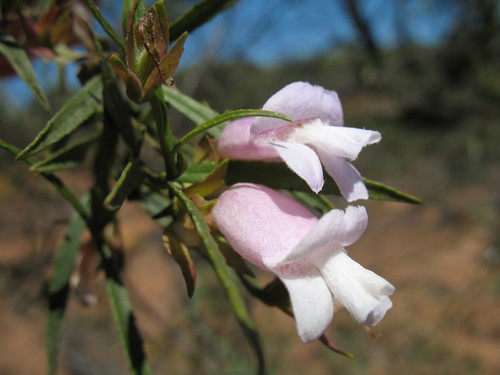
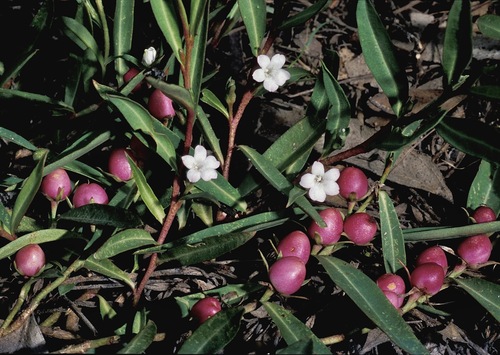
Eremophila debilis is a prostrate shrub with spreading stems that can grow up to 1 meter (3 feet) long. It produces glossy green leaves that are elliptic, lance-shaped, or egg-shaped. Most leaves are 32–85 mm (1–3 in) long and 8–20 mm (0.3–0.8 in) wide, are glabrous, and grow on a 1–3 mm (0.039–0.118 in) petiole. Leaf edges usually bear 3 or 4 pairs of prominent teeth. Flowers grow singly or in groups of up to 3 in leaf axils, on a stalk that is 3.5–7.5 mm (0.1–0.3 in) long. There are 5 green, lance-shaped, slightly overlapping sepals that are mostly 7–10 mm (0.3–0.4 in) long. Petals measure 8.5–11 mm (0.3–0.4 in) long and are joined at their lower end to form a tube. The petal tube is white to pale mauve, and unlike most other species in the genus Eremophila, it does not have spots. The outside of the petal tube and its lobes are mostly glabrous, but the inside of the tube is filled with soft hairs. The 4 stamens are fully enclosed inside the petal tube. Flowering occurs mainly in spring and summer, and is followed by rounded, fleshy fruits that are white to reddish purple, and 7–10 mm (0.3–0.4 in) in diameter.
In terms of distribution and habitat, Eremophila debilis is widespread across eastern Queensland and New South Wales, growing in a broad range of soils and vegetation types. It often occurs in box and white cypress plant communities, and sometimes forms dense mats. It has been recorded growing near Boosey in Victoria. The species is also present in New Zealand, where it is thought to have become naturalised.
In horticulture, this plant, commonly called winter apple, is well known, though it is often grown under the synonym Myoporum debile. It is suitable for use as a groundcover in many locations, as long as the soil is reasonably well-drained. Its flowers, fruit, and foliage are all considered attractive features. It is frost hardy, and will layer in ideal growing conditions. Propagation from seed is difficult, but propagation from hardened cuttings of the current year's growth is easy.