About Eremophila bowmanii F.Muell.
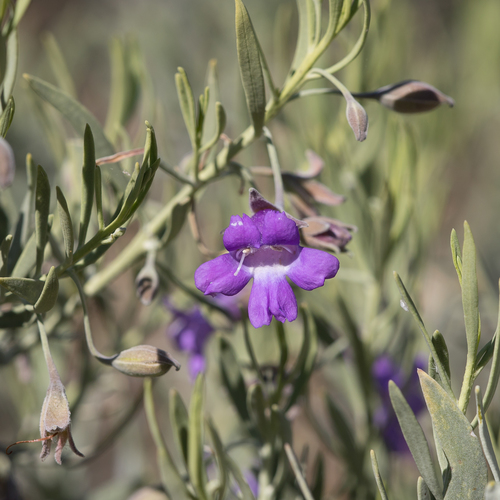
Eremophila bowmanii F.Muell. is a shrub that typically reaches 1.5 metres (5 feet) in both height and width, though it sometimes grows as tall as 3 metres (10 feet). Its branches, leaves, flower stalks, and sepals are all covered in tangled silvery hairs, giving the entire plant a silvery-grey appearance. The leaves measure 9–50 mm (0.4–2 in) long and 1–11.5 mm (0.04–0.5 in) wide, and their shape ranges from linear to egg-shaped or nearly circular. Flowers are usually borne singly in leaf axils, on a stalk 6–19 mm (0.2–0.7 in) long. There are 5 pointed green to purple sepals, 12–19 mm (0.5–0.7 in) long, covered in silvery hairs. The petals are 21–30 mm (0.8–1 in) long and joined at their lower end to form a tube. The petal tube is purple or lilac, rarely white, and sometimes has small purple spots inside the tube. Most of the tube and its end petal lobes are glabrous, except the inside of the tube, which is woolly. Four stamens are entirely enclosed within the petal tube. Flowering occurs mostly from winter to late spring, followed by oval-shaped woody fruits 6–8.5 mm (0.2–0.3 in) long with a papery covering. Eremophila bowmanii is widespread and common in central northern New South Wales and southern Queensland, where it grows in red soils within mulga, mallee, and woodland habitats. There is a single recorded occurrence of this species in South Australia. This species sometimes grows in dense stands, which can indicate overgrazing of grasses by livestock; however, Eremophila bowmanii itself is not usually eaten by cattle or sheep. Commonly called silver turkeybush, this species is a popular garden plant, and is considered one of the most attractive small grey-leaved eremophilas. It can be propagated from seed or cuttings, but requires grafting onto Myoporum species when grown in temperate areas such as Sydney, or when planted in alkaline soil. It grows best in well-drained soil positioned in full sun, and is both drought and frost tolerant.