About Equus ferus Boddaert, 1785
Body Size Variability Drivers
Wild horses show considerable variability in body size and limb dimensions across time and space, which is likely an adaptation to local environmental and climatic conditions.
Przewalski's Horse Body Mass
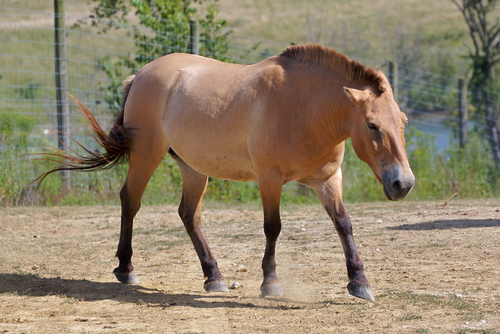
The living Przewalski's horse has an estimated body mass of 250–360 kilograms (550–790 lb), and its body mass varies considerably following rhythmic annual cycles.
Extinct Wild Horse Body Mass
Some extinct wild horse populations are thought to have been much larger. Pleistocene European wild horses, including those assigned to Equus (ferus) mosbachensis and Equus (ferus) latipes, are suggested to have had body masses of around 500–607 kilograms (1,102–1,338 lb).
Anatomical Differences Between Horse Populations
Earlier Middle Pleistocene horses, such as those assigned to E. (ferus) mosbachensis, differ from later wild horses in some anatomical features of the limbs and teeth.
Historical Wild Horse Distribution
During the Late Pleistocene and early Holocene, wild horses were formerly widespread across the Old World. Their range extended from Western Europe and North Africa (where remains are classified as Equus algericus) to the far north of Siberia (where they are classified as Equus lenensis) and East Asia.
Current Przewalski's Horse Status
Today, Przewalski's horse is the only living wild horse subspecies. It was formerly extinct in the wild, and has been reintroduced to small areas across its former distribution in northeast China, Mongolia and Kazakhstan, as well as to areas outside its historical distribution including Spain.
Wild Horse Habitat Tolerances
Wild horses have broad environmental tolerances. Historically, they have inhabited environments ranging from temperate forest to steppe (including the prehistoric mammoth steppe biome) and tundra, though they generally tend to prefer open environments.
General Horse Feeding Habits
Horses are typically considered grazers. They can have seasonal food preferences, which is seen in Przewalski's horse: historically, the subspecies consumed browse like shrubs during winter months, because human pressure forced it into suboptimal habitat.
Extinct Pleistocene Horse Feeding Patterns
Dental wear in some extinct Pleistocene wild horse populations that lived in forested environments suggests these populations were mixed feeders, or even predominantly browsers during certain times of the year, though this pattern may reflect consumption of low growing forbs rather than shrubs.
Wild Herd Social Structure
Wild horses live in herds with a social hierarchy. Herds are formed by a dominant adult male, or sometimes multiple dominant males (called harem stallions), alongside several mares and their offspring.
Harem Stallion Behavior
The harem stallion aggressively defends his herd or harem against rival males. When they reach adulthood, both male and female horses disperse to other herds to avoid inbreeding.
Bachelor Group Behavior
Young adult males form bachelor groups when they are around 3 years of age. In these bachelor groups, male horses engage in play and ritual behaviour, and the group develops its own hierarchy.
Przewalski's Horse Reproduction
Female Przewalski's horses tend to start giving birth around 3 years of age. The gestation period for Przewalski's horse is around 12 months, and mares primarily give birth in spring or summer. Przewalski's stallions generally leave bachelor groups to start breeding at around 5–6 years of age.
Wild Horse Predators
In modern times, wolves are the main predator of wild horses in Eurasia. During the Pleistocene, wild horses had other predators, including cave hyenas.