About Epinephelus areolatus (Forsskål, 1775)
Size
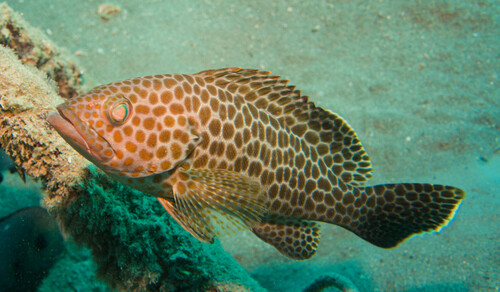
The areolate grouper (scientific name Epinephelus areolatus (Forsskål, 1775)) is a large fish that grows up to 47 cm long and weighs up to 1.4 kg, and lives near coral reefs.
Coloration
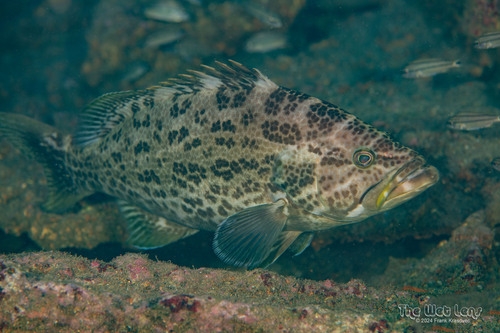
Its body is colored whitish to gray, covered with rounded brownish spots. A key identifying feature is the narrow, straight white margin on its truncate tail.
Identification
It has 11 dorsal spines, 15-17 dorsal soft rays, 3 anal spines, and 8 anal soft rays. It is often mistaken for the brownspotted grouper Epinephelus chlorostigma found in the Persian Gulf, as well as several other species that have many spots.
Range
The areolate grouper lives in tropical waters within the coordinates 35°N - 33°S, 29°E - 180°E, across the Indo-Pacific region. Its range extends from the Red Sea and Persian Gulf to Natal, South Africa, east to Fiji, north to Japan, and south to the Arafura Sea and northern Australia.
Records
It has been recently recorded in Tonga, but does not appear to be present in most areas of the western Indian Ocean. In 2015, a single specimen was reported from the Mediterranean Sea, off the coast of Israel.
Habitat
This species is typically found in shallow continental shelf waters, in seagrass beds or on fine sediment bottoms near rocky reefs, dead coral, or alcyonarian corals. Juveniles are commonly found at depths up to 80 m (260 ft).
Early Life
Eggs and early larvae of the areolate grouper are likely pelagic.
Reproduction
Like other groupers, the areolate grouper is a sex-changing species: all young individuals are female, and some change sex to male as they reach maturity. The species reaches maturity when it reaches a fork length of 22 cm (8.7 in). Spawning usually occurs in the months of May, June, October, and December.
Diet
After hatching, wild areolate grouper larvae feed on copepods and other small zooplankton. Adult areolate groupers prey on fish and benthic (bottom-dwelling) invertebrates, primarily prawns and crabs.