About Epidendrum calanthum Rchb.f. & Warsz.
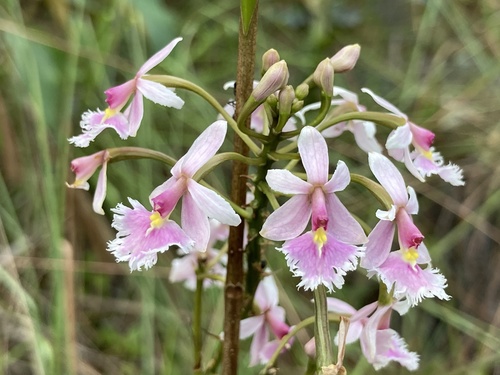
Epidendrum calanthum Rchb.f. & Warsz. shares multiple traits with other members of the subgenus *Epidendrum* subg. *Amphiglottium* Lindl. (1842): a sympodial growth habit, terete stems covered from the base with close, tubular, distichous leaf-bearing sheathes on the upper stem, and a terminal peduncle covered from its base with close, tubular sheathes. The stem reaches 1 m in height below the inflorescence, and the inflorescence itself grows to 0.4 m tall. White to pink resupinate flowers are produced in a congested raceme at the end of the inflorescence. Its leaves grow to 10 cm long. Oblong sepals measure 9 mm long. Petals are also 9 mm long, but are narrower than the sepals, with serulate to erose edges. The broad, lacerate lip is adnate to the column up to its apex, and is trilobate, which is typical for *Epidendrum* sect. *Schistochila*. The lacerations along the lobe margins are nearly as deep as the gaps between the lobes, making the lip appear almost entire. The central lobe is divided in two at its apex, and bears the keel (or carina) that is characteristic of *Epidendrum* subsect. *Carinata*. This keel starts near the apex of the column, between two small bumps, and extends almost to the apex of the lip. The diploid chromosome number of *Epidendrum calanthum* has been determined as 2n = 30. Although *E. calanthum* is very similar in appearance to *E. imatophyllum*, because both species have nearly undivided lips, Dodson & Vásquez (1989) note that the two species can be easily distinguished: *E. calanthum* has resupinate flowers, while the flowers of *E. imatophyllum* are non-resupinate. This species can hybridize with other *Epidendrum* species, which blurs species boundaries in sympatric populations.