About Desmognathus ocoee Nicholls, 1949
Nomenclature and Etymology
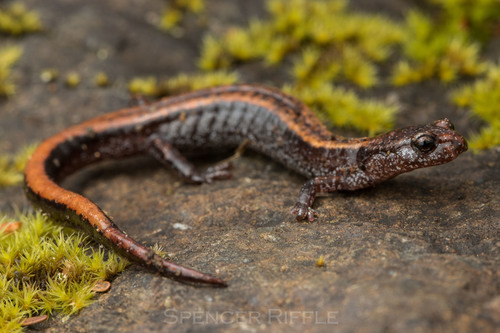
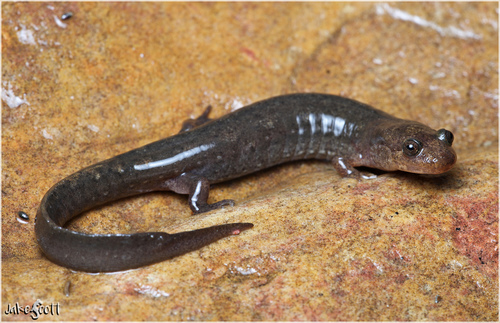
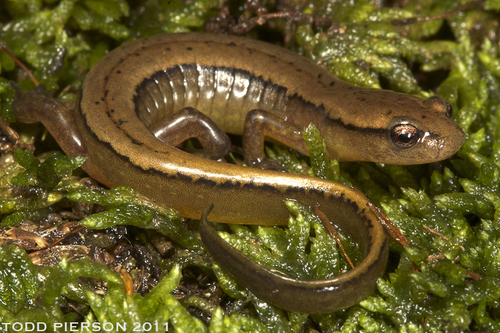
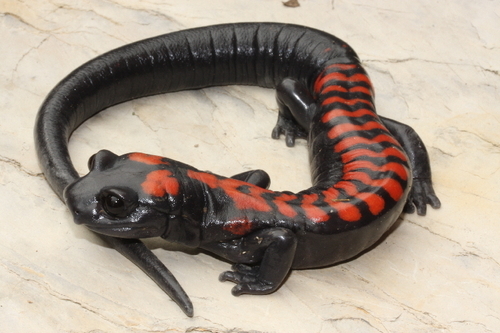
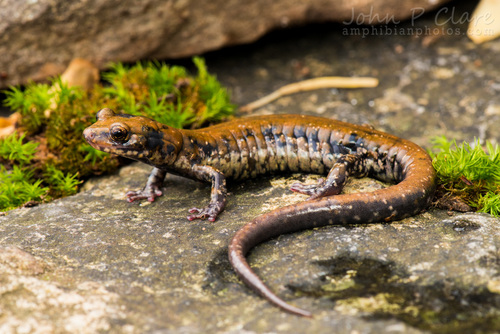
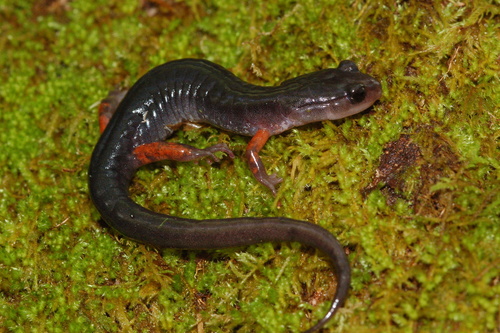
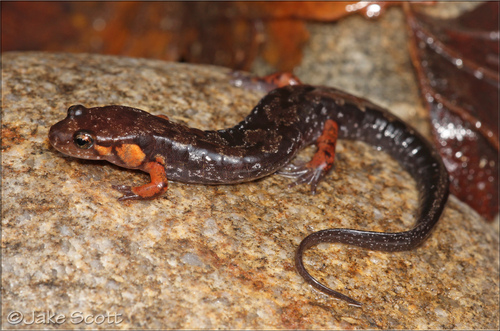
The ocoee salamander, scientifically Desmognathus ocoee, is a small mountain dusky salamander that displays a wide variety of colors and patterns. The species gets its name from the Cherokee word "ocoee", which refers to Passiflora incarnata (passionflower), the Tennessee state wildflower and symbol. Both the Ocoee River and the ocoee salamander take their name from this Cherokee term for passionflower.
Coloration and Markings
Some individual ocoee salamanders have distinct red, yellow, or orange patches on their legs and cheeks. Populations located in central Tennessee, northwestern Georgia, and northeastern Alabama are typically dark brown or black, with faded larval spots.
Morphological Traits
Compared to other species in the Desmognathus genus, Desmognathus ocoee has smaller bodies measuring around 7–11 cm in length, shorter and narrower heads, longer limbs, and no vomerine teeth in adult males. Juveniles have pairs of alternating pale spots along their middorsal line; these spots may fuse together as individuals reach adulthood.
Population Distribution
The ocoee salamander occurs in two separate populations. The larger, more common population inhabits the Blue Ridge Mountains and lower elevations in the gorges of the Hiwassee, Ocoee, Tugaloo, and Tallulah rivers. The smaller, less numerous population is found on the Appalachian Plateau in northeastern Alabama.
Altitudinal Range
This species occupies a wider range of altitudes than any other member of the genus Desmognathus. At lower altitudes it is aquatic, while at higher altitudes it is mostly terrestrial.
Habitat Preferences
It is always found near fast-flowing mountain streams, in seepage areas, on moist forest floors, and on wet rocks. In cove valleys of the Appalachian Mountains, it prefers hardwood forests with trees over 85 years old.
Ecological Role
Semi-aquatic salamanders like the ocoee salamander contribute substantially to terrestrial vertebrate biomass. While they depend on water for reproduction, their short larval period lets them use wetted habitats such as small streams and wet rock faces.
Terrestrial Adaptations
Even so, this species is the most terrestrial of all stream-breeding Desmognathus salamanders. When conditions are moist, individuals will leave streambeds and move into the forest. They prefer cove forests over 85 years old that have a large number of emergent rocks.
Egg Survival Requirements
These rocks help retain soil moisture, making them critical for the survival of D. ocoee eggs during brooding.
Food Web Role
As vertebrate predators, D. ocoee plays an important role in the food web dynamics of its habitat.
Population Density
Individuals are often found some distance from water sources, most commonly in forests at higher elevations. On wet rock faces, population density reaches around six adults per square meter.
Population Trends
Overall, population trends for ocoee salamanders in the Appalachian Mountains have not changed significantly over the past twenty years.