About Emberiza bruniceps J.F.Brandt, 1841
Taxonomy
The red-headed bunting, scientifically named Emberiza bruniceps, is a passerine bird belonging to the bunting family Emberizidae.
Breeding Distribution
This species breeds across central Asia, with breeding populations found in Afghanistan, Iran, Kazakhstan, Kyrgyzstan, Mongolia, the Russian Federation (including European Russia and Central Asian Russia), Tajikistan, Turkmenistan, Uzbekistan, and China.
Migratory Pattern
It is a fully migratory bird that spends the winter in India and Bangladesh.
Vagrant Status in Western Europe
In western Europe, this species occurs only as a vagrant, and its wild status there has been confused by records of escaped captive birds.
Taxonomic Comparison with Black-headed Bunting
This confusion persists even though red-headed bunting is more commonly recorded in the region than the closely related black-headed bunting, which actually has a more westerly breeding range.
Population Trend in Britain
Reports of this species in Britain have dropped dramatically in recent years.
Threat to Populations
This decline matches widespread reductions in some Emberizidae species caused by the impact of illegal wildlife trade.
Wild Origin Confirmation
One individual found on Shetland in 2010 was confirmed to be of wild origin.
Breeding Habitat
Red-headed buntings breed in open scrubby landscapes, which includes agricultural land.
Nesting and Clutch Size
They build their nests in trees or bushes, and lay clutches of three to five eggs.
Diet
Their natural diet consists mainly of seeds, but they feed insects to their young.
Size and Morphology
This species reaches 17 cm in total length, making it larger than the reed bunting, and has a long tail.
Breeding Male Plumage
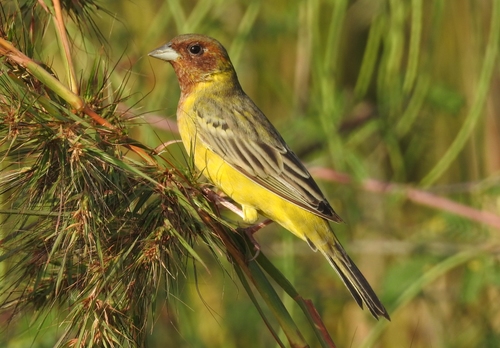
Breeding males have bright yellow underparts, green upperparts, and a brownish-red face and breast.
Female Plumage
Females are a paler, less distinct version of breeding males, with paler underparts, a grey-brown back, and a greyish head.
Juvenile Plumage
Juveniles have a similar plumage to females.
Plumage Identification Challenge
Both females and juvenile red-headed buntings can be very difficult to distinguish from the matching age and sex plumages of black-headed buntings.
Male Vocalization
Males sing from high perches, producing a jerky song transcribed as sweet-sweet-churri-churri-churri.