About Elymus canadensis L.
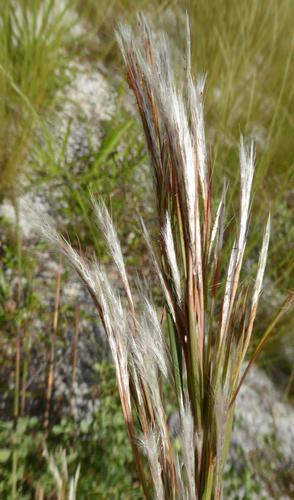
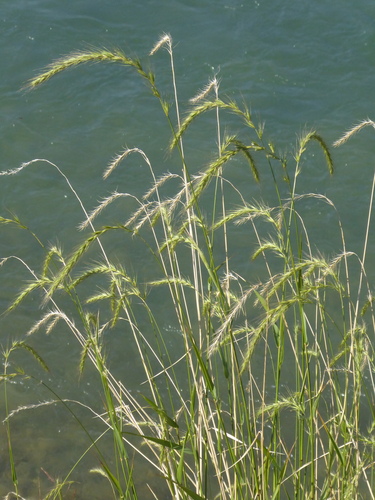
Elymus canadensis L., commonly known as Canada wild rye, is a perennial bunchgrass. It reaches heights of 1 to 1.5 metres (3 ft 3 in to 4 ft 11 in). It grows from a small rhizome, forms a shallow, fine root network, and is a facultative mycotroph, receiving an average of about 25% of its nutrients from symbiotic mycorrhizae. At maturity, its stems are hollow and tough, and they bear rough, flat leaves. The leaves can grow up to 15 mm (0.59 in) wide, and are 20 to 30 cm (8 to 12 in) long. Its inflorescence is a nodding spike that grows up to 25 cm (10 in) long, holding 5 to 20 spikelets. Each spikelet is 1 to 2 cm (1⁄2 to 3⁄4 in) long, not counting its sharp, hard, curling awn that may exceed 3 cm (1+1⁄4 in) in length. Many forms and varieties of this species have been named, but none are accepted in Kew's Plants of the World Online. Canada wild rye is sometimes used to stabilize eroded areas and to establish vegetation on metal-rich soils at reclaimed mine sites. Elymus canadensis is an allotetraploid. It primarily reproduces by self-pollination, but can cross-pollinate with several other Elymus strains to generate greater genetic variation. This ability to cross-pollinate allows new species to arise through natural processes or breeding programs, producing plants that may lead to the development of novel crops. The cultivar 'Homestead' produces a larger volume of forage and has higher digestibility than the adapted experimental strain it was compared against. The current primary intended use of 'Homestead' is in conservation, roadside, and grassland seeding mixtures.