About Eleutherodactylus planirostris (Cope, 1862)
Common Name and Size
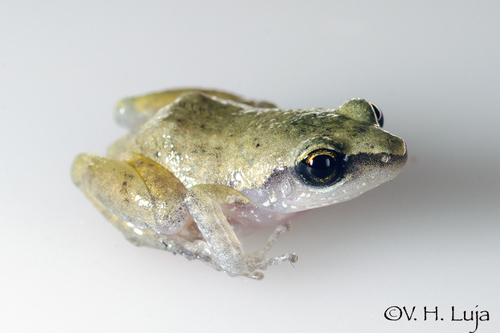
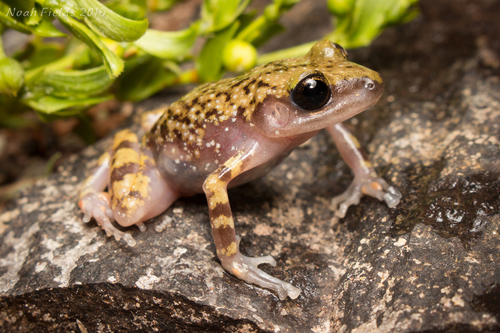
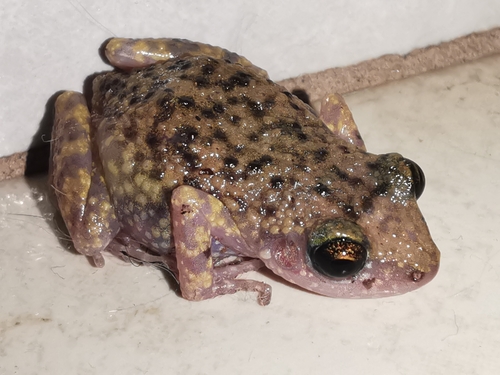
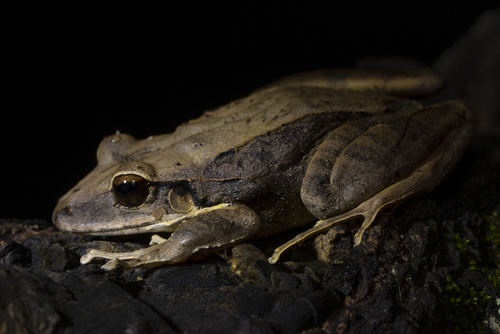
Eleutherodactylus planirostris, commonly known as the greenhouse frog, is a very small species ranging from 17 to 31 mm (0.67 to 1.22 in) in length.
Dorsal Coloration Patterns
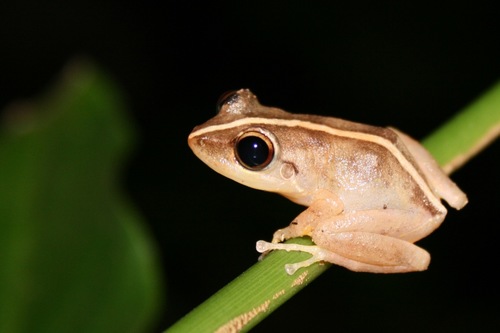
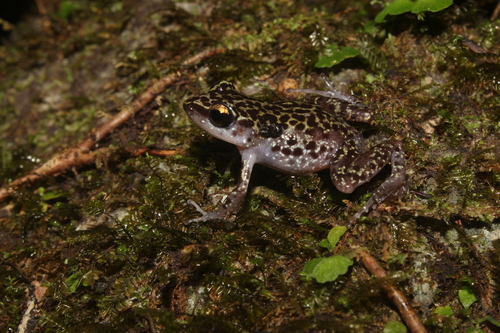
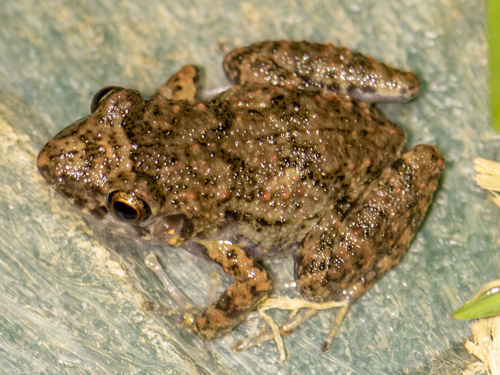
These frogs are usually drab or olive-brown, and occur in two forms; one has two broad stripes running longitudinally down the back, and the other is mottled.
Ventral Coloration and Eye Trait
The undersides of both forms are a paler colour than the back, and the eyes are red.
Native Distribution
The greenhouse frog is native to Cuba and some other islands in the West Indies.
Introduced Range in the United States
It has been introduced to Hawaii and Florida, where it has become common. It has been sporadically found in southern Georgia, southern Alabama and eastern Louisiana.
Additional Introduced Populations
It is an introduced species in Jamaica, Guam and Shenzhen, China.
Typical Habitat and Activity Pattern
It lives in moist leaf litter, often near human habitations, but is seldom seen because it is nocturnal.
Emergence and Hibernation Behavior
It sometimes emerges on warm, rainy days in summer, and in Florida, it has been found hibernating in March under the flaking bark of a wild tamarind (Lysiloma) tree.
Unusual Egg Laying Trait
The greenhouse frog is unusual in that its eggs are not laid in water or in a frothy mass as seen in some tree frogs.
Egg Placement Characteristics
Instead, the eggs are enclosed in a thick membrane and laid singly in concealed, damp locations, such as beneath a log, buried in debris, or even under a flower pot.
Clutch Size Range
In Florida, clutch sizes vary between three and 26 eggs.
Direct Development Process
The tadpoles complete their development while still inside the egg, and emerge as fully developed juvenile frogs about 5 mm (0.20 in) long with a short tail that soon gets reabsorbed.
Egg Incubation Period
In warm conditions, hatching may occur on the 13th day of development.
Hatching Adaptation
The tadpoles have an "egg tooth" on the end of their snouts to help them emerge from the egg case.
Egg Tooth Fate Post-Hatching
Afterwards, this is no longer of use, so it is shed.
Parental Care Behavior
Adult frogs may provide some parental care by guarding the eggs, as frogs have been observed lurking in the vicinity of egg clumps.