About Echinacea tennesseensis (Beadle) Small
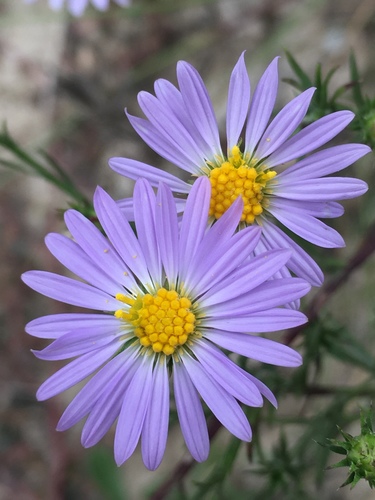
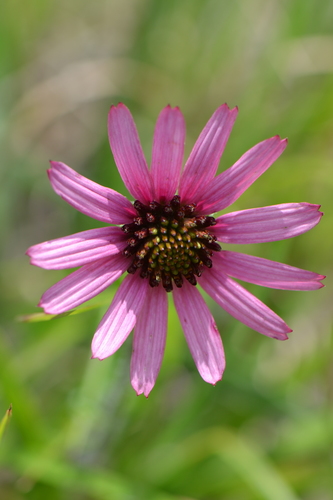
Echinacea tennenseensis (Beadle) Small is a herbaceous perennial plant that grows up to 75 centimeters (2.46 feet) tall. Its leaves are hairy, lanceolate, arranged in a basal whorl, and only a small number of small leaves grow on the flower stems. It produces flowers in capitula (flowerheads) that can reach up to 8 centimeters (3.2 inches) across; each flowerhead has a ring of purple ray florets surrounding brown disc florets. A distinct characteristic of this species is that its ray flowers are generally erect, which differs from the more drooping ray flowers of its closest relative E. angustifolia — a species widespread across the prairies of the central United States — as well as other common Echinacea species such as E. purpurea. Echinacea tennesseensis is a rare species, found in fewer than 10 locations within Davidson, Wilson, and Rutherford Counties. Researchers have hypothesized that an ancestral Echinacea species spread into middle Tennessee during the hypsithermal period that followed the last ice age. At that time, conditions were drier and prairies extended across much of the central eastern U.S. that is currently covered by forest. As regional conditions became wetter, Echinacea populations became isolated on the prairie-like habitat of cedar glades, which were eventually surrounded entirely by forest. This isolation led to genetic divergence and the speciation of E. tennesseensis.