About Echinacea simulata Mc Gregor
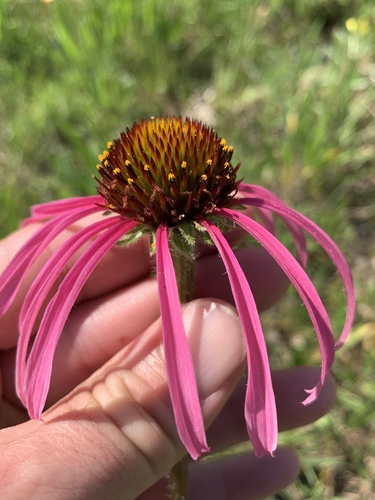
Echinacea simulata is very similar in appearance to Echinacea pallida, which has a different chromosome number. The most easily recognized distinguishing morphological feature is that Echinacea simulata has yellow pollen grains. Additional research is required to clarify further physical and ecological differences between these two taxa. This species grows from a branched fusiform taproot, producing usually unbranched stems that reach up to 100 centimetres (3.3 ft) tall. Its foliage and stems are covered in sparsely to densely distributed spreading hairs, and stems are mostly green or mottled with purple. The plant produces both basal leaves and stem leaves; leaves are alternate, simple, lanceolate, 5–40 centimetres (2–16 in) long, and usually have 3 primary veins. Basal leaves and lower stem leaves have petioles 4–20 centimetres (1.6–7.9 in) long, while upper stem leaves have shorter petioles or are completely sessile (lacking petioles). Plants normally produce a single flower head held on a peduncle 20–40 centimetres (8–16 in) long. Ray corollas are typically soft rose to pink, and very rarely off white. There are usually 8 to 21 drooping rays 4–9 centimetres (1.6–3.5 in) long, which surround a central cone-shaped disk. The phyllaries (bracts) located below the flower heads are lanceolate to ovate, 1.5–3 centimetres (0.059–0.118 in) long and 7–15 millimetres (0.28–0.59 in) wide. Seeds develop in angled fruits called cypselae, which are tan, 3–4.5 millimetres (0.12–0.18 in) long, have smooth surfaces, and normally lack hairs. Echinacea simulata is native to the east-central United States, specifically the states of Arkansas, Georgia, Kansas, Missouri and Tennessee. The U.S. Department of Agriculture also reports it as native to North Carolina and Virginia. It is rare in Alabama, Georgia, and Tennessee, and is recorded as introduced in Illinois. This species has a relatively small overall distribution, and the full extent of its range is still being determined. It grows in glades and open woodlands, and prefers dry, calcareous soils. This species blooms from late spring to midsummer. Butterflies and bees are attracted to its nectar, and birds eat its seeds during late summer and fall.