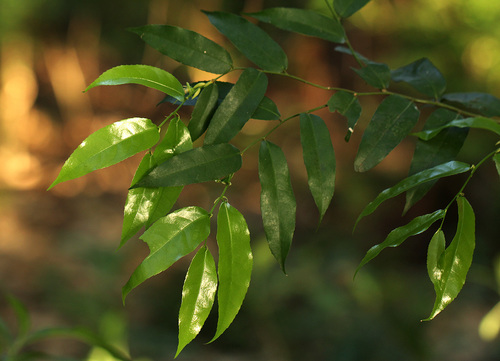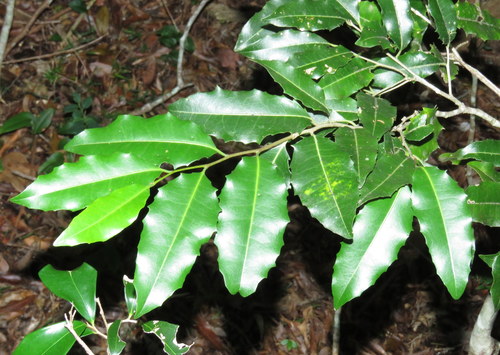
About Drypetes deplanchei (Brongn. & Gris) Merr.
Taxonomic Naming
Drypetes deplanchei (Brongn. & Gris) Merr. is a small to medium-sized tree that grows up to 25 metres tall, with a trunk that can reach 60 cm wide.
Trunk Base Features
The base of the trunk and its lower section often have flanges.
Bark Appearance
The bark is grey or brown, and regularly sheds bark scales that leave shallow depressions, creating a mottled appearance similar to tulipwood. On older trees, the bark is scaly and pustular.
Small Branch Characteristics
Small branches are smooth, slender, grey, and dotted with many lenticels.
Main Species Distribution
This species occurs from as far south as the Hunter River, New South Wales, north to Torres Strait, and extends across the Top End of the Northern Territory and into The Kimberley region of Western Australia.
Subspecies Distribution
The subspecies affinis is endemic to Lord Howe Island.
Habitat Range
It occupies a range of habitats, most commonly monsoon forest, drier rainforest, littoral rainforest, and riparian rainforest alongside streams.
Insect Food Source
It acts as a food source for a variety of insects, including the common albatross butterfly. It may also be a food source for the critically endangered Lord Howe Island stick insect.
Historical Settler Use (New South Wales)
Historically, the tree was used to make bullock whip handles in the Richmond River district of northern New South Wales.
Indigenous Australian Uses
Indigenous Australians ate its raw fruit, used its leaves in cooking, and carved its wood for use.
Lord Howe Island Timber Use
Early settlers on Lord Howe Island used its timber for sea piles, because the tree's sap repels marine worms.