About Drypetes arguta (Müll.Arg.) Hutch.
Growth Habit
Drypetes arguta (Müll.Arg.) Hutch. is a small tree or large straggling shrub that grows to roughly 8 meters (26 feet) in height.
Bark Features
Its bark is grey, and it is either smooth or marked with fine vertical furrows.
Leaf Arrangement
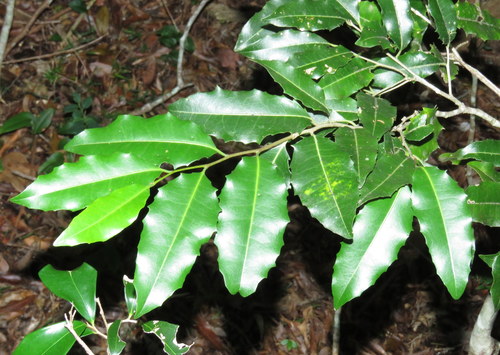
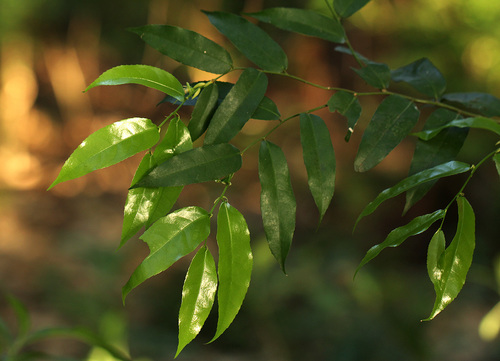
Its leaves have short stalks, a pair of yellow linear stipules at their base, and grow in an alternating arrangement along slender, greyish twigs.
Leaf Characteristics
The leaves are bright green, elliptical to lanceolate in shape, with uneven bases and tapered tips, reaching up to 11 cm (4.3 in) in length. Glands are present at the tips of the leaf marginal teeth.
Flower Traits
Flowers grow either singly or in clusters in the leaf axils; they are unisexual, with male and female flowers growing on separate individual trees.
Fruit Characteristics
The flowers are yellowish-green, fragrant, and develop into globular, fleshy fruits up to 2 cm (0.8 in) in diameter that turn orangish-red when ripe.
Distribution
This species is native to eastern Africa, with a range that extends from Tanzania and Zimbabwe southward to Mozambique, Eswatini, and KwaZulu-Natal in South Africa.
Habitat
It grows in forests and along watercourses at elevations up to 600 m (2,000 ft). It is also a major component of the flora of the Southern African Sand Forest, a woodland habitat growing on ancient sand dunes along the border between southern Mozambique and northern KwaZulu-Natal.
Traditional Uses
Traditionally, sections of branches from this tree have been used to build huts, and its wood has also been used to manufacture sticks. The fruits are edible, and have been used to produce a fermented alcoholic drink.