About Drosera peltata Thunb.
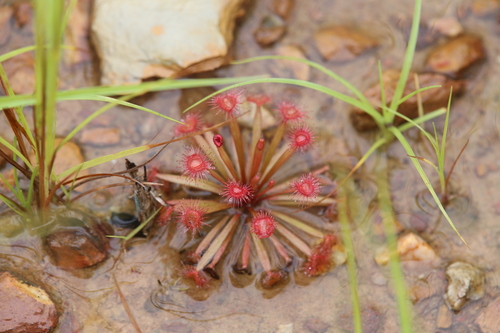
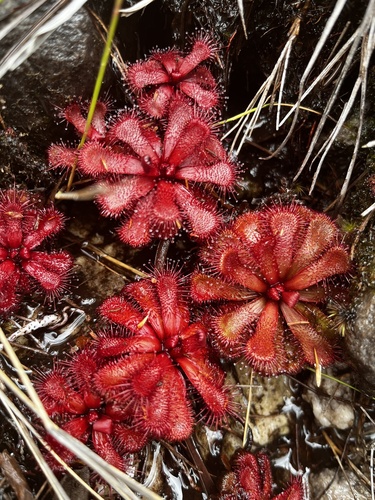
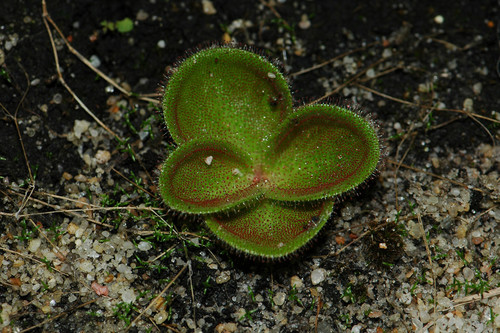
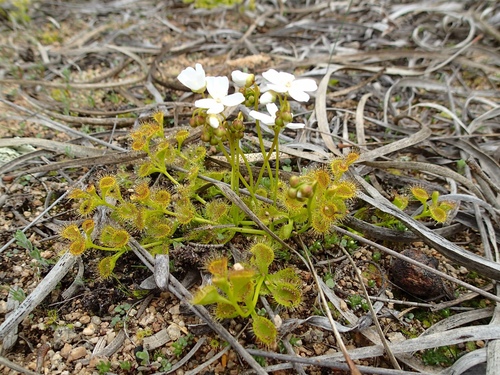
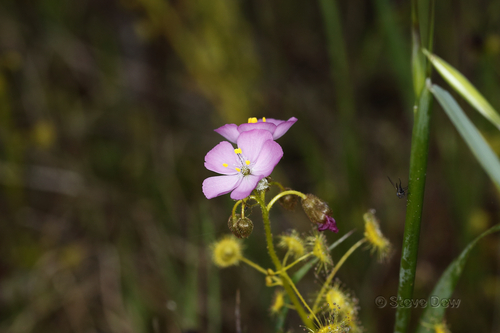
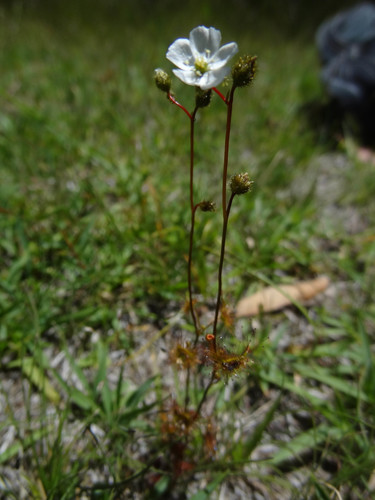
Drosera peltata Thunb. is a perennial tuberous herb. Its underground tuber generally grows 4–6 cm beneath the soil surface, and its aerial parts reach 5–50 cm in height. The species has wide variation into several distinct forms and subspecies. The subspecies D. peltata subsp. auriculata is typically the most robust, growing up to 50 cm tall, while the informal form D. foliosa is usually the shortest, often only 5–10 cm high. Drosera peltata usually has a clear rosette of leaves at the soil surface. This rosette is most prominent in D. foliosa, and is often reduced to scales in mature plants of D. peltata subsp. auriculata. The aerial stem is simple or slightly branched in the nominal form of D. peltata, as well as in D. peltata subsp. auriculata and the informal form D. gracilis. Flower color is variable, but is generally white or light pink. Whole plant color is also highly variable: D. foliosa is generally bright grass green even when growing in direct sunlight; D. peltata subsp. auriculata is often tinged with varying amounts of red, and may even be solid red; D. gracilis is always orange or dark red. Drosera peltata is commonly found on frost-free open flats with light scrub, in regenerating forest areas, on grassy verges, and on roadside cuttings. It grows mainly in soft fine clay, peaty, or sandy soils that are wet in winter and dry out over summer. This species has a large range, and its various forms occur naturally in southern, eastern, and south-west Australia, Tasmania, New Zealand (Northland), as well as south-east Asia and India. Drosera peltata is one of the easiest tuberous Drosera to cultivate, a trait attributed to its forgiving nature regarding water and temperature. Tuberous Drosera generally need wet, cool winters (their active growing season) and warm, nearly completely dry summers, otherwise dormant tubers will rot. Drosera peltata can tolerate wetter summers than most other tuberous Drosera.