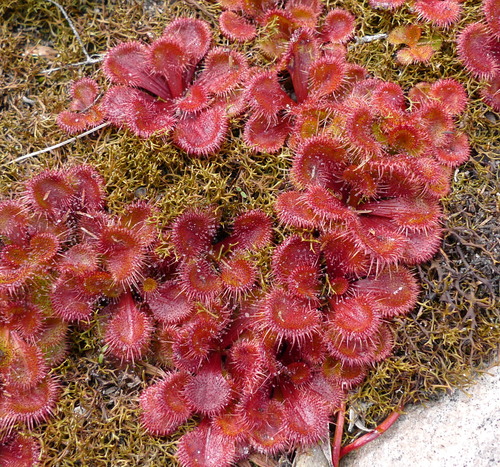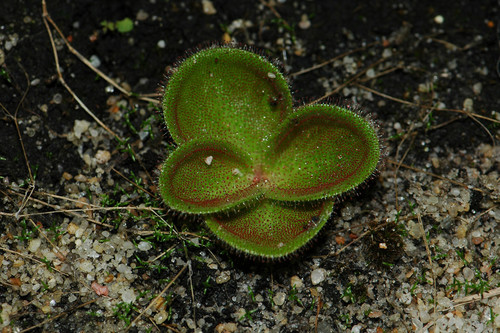
About Drosera erythrorhiza Lindl.
Common Name and Basic Classification
Drosera erythrorhiza, commonly known as the red ink sundew, is a perennial tuberous carnivorous plant in the genus Drosera.
Endemic Range and Growth Form
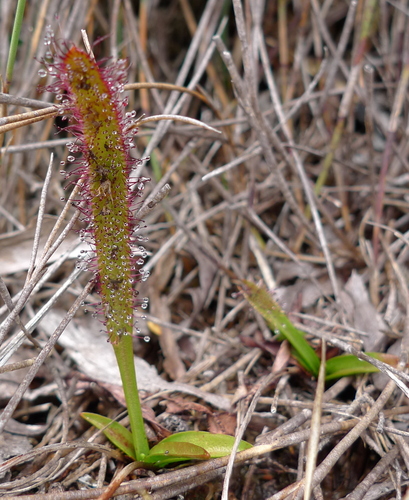
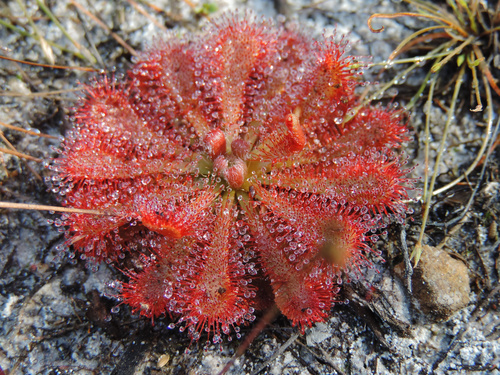
It is endemic to Western Australia and grows in a rosette form.
Species Distinguishing Feature
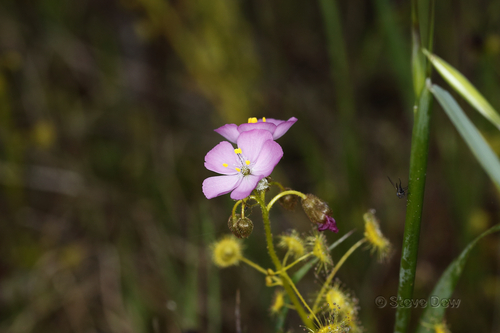
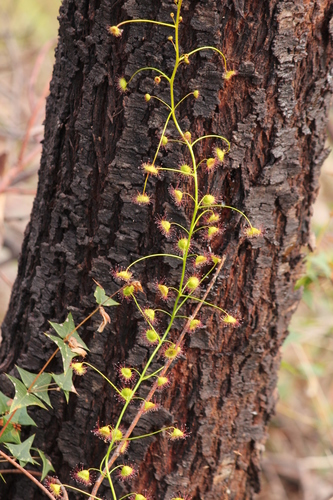
It can be distinguished from other species in Drosera section Erythrorhiza by its many-flowered cymose inflorescences, which can hold up to 50 individual flowers.
Initial Formal Publication
This species was first formally described by John Lindley in his 1839 publication A sketch of the vegetation of the Swan River Colony.
1992 Subspecies Description
In 1992, N. G. Marchant and Allen Lowrie described three new subspecies of this variable species, which also created the autonym D. erythrorhiza subsp. erythrorhiza. The subspecies were primarily separated based on leaf morphology and distribution.
Subspecies collina Characteristics
D. erythrorhiza subsp. collina is named for its native hilly habitat, and typically produces more leaves of varying shapes within a single rosette.
Subspecies erythrorhiza and magna Comparison
D. erythrorhiza subsp. erythrorhiza has fewer, wider leaves compared to D. erythrorhiza subsp. magna, which has larger, wider leaves and often produces more leaves overall.
Subspecies squamosa Original Publication
D. erythrorhiza subsp. squamosa was originally described as a full species, Drosera squamosa, by George Bentham in 1864.
Subspecies squamosa Reclassification
Marchant and Lowrie reclassified this taxon as a subspecies of D. erythrorhiza. Subspecies squamosa differs from subsp. erythrorhiza by the appearance of its red leaf margins, which are caused by dense red tentacles.
1906 Variety Publication
Earlier in 1906, Ludwig Diels published a new variety, D. erythrorhiza var. imbecilla, in his taxonomic monograph of the Droseraceae family.
1999 Alternative Taxonomy Proposal
In 1999, Jindřich Chrtek and Zdeňka Slavíková proposed an alternative competing taxonomy. The authors argued for reclassifying all tuberous Drosera, which make up the entire Drosera subgenus Ergaleium, into Johann Georg Christian Lehmann's 1844 genus Sondera, which had previously been reduced to a synonym of Drosera.
Reclassified Species Names
In this reclassification, Chrtek and Slavíková elevated Marchant and Lowrie's subspecies to full species rank, establishing Sondera collina, S. erythrorhiza, S. magna, and S. squamosa.
Alternative Taxonomy Acceptance
This alternative reclassification is not widely followed by the scientific community.