About Diuris magnifica D.L.Jones
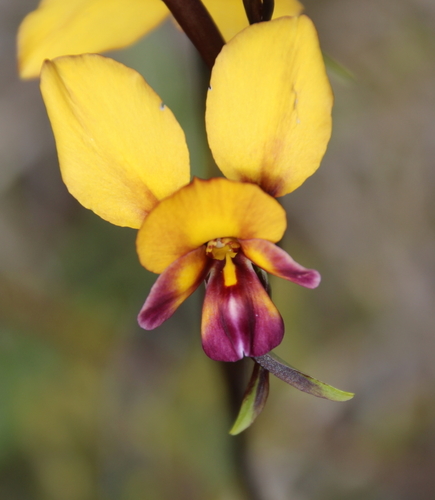
Diuris magnifica is a tuberous perennial herb that typically reaches a height of 300 to 600 mm (10 to 20 inches). Two to three leaves grow from its base; each leaf is 120–220 mm (5–9 inches) long, 18–24 mm (0.7–0.9 inches) wide, and folded along its length. This species produces between three and nine flowers that are golden-yellow with purple markings, each 40–60 mm (1.6–2.4 inches) long and 30–50 mm (1–2 inches) wide. The dorsal sepal is egg-shaped, 12–17 mm (0.5–0.7 inches) long and 10–16 mm (0.4–0.6 inches) wide, and curves upwards. The lateral sepals are linear to lance-shaped, 16–26 mm (0.6–1 inch) long, about 3 mm (0.1 inch) wide, and are turned downwards, usually crossing each other. The petals are erect, with an egg-shaped blade 20–30 mm (0.8–1 inch) long and 12–14 mm (0.5–0.6 inches) wide that sits on a purplish-brown stalk 4–6 mm (0.16–0.24 inches) long. The labellum is mauve or purple with some yellow markings, 13–18 mm (0.5–0.7 inches) long, and has three lobes. The central lobe is wedge-shaped, 8–14 mm (0.3–0.6 inches) long and 9–15 mm (0.4–0.6 inches) wide. The side lobes are 10–16 mm (0.4–0.6 inches) long and 5–8 mm (0.2–0.3 inches) wide. A single yellow, ridged callus 2–3 mm (0.08–0.1 inch) long runs along the midline of the labellum. This species is similar to other Diuris species including D. corymbosa and D. amplissima, but differs from them in size, flowering period, and distribution. Flowering occurs from late August to October. This species, commonly called the large pansy orchid, is common in near-coastal shrubland and woodland between Lancelin and Mandurah, in the Geraldton Sandplains, Jarrah Forest, and Swan Coastal Plain biogeographic regions. At the northern end of its distribution, Diuris magnifica hybridises with the currently undescribed Arrowsmith pansy orchid (Diuris sp. 'Eneabba'), and it hybridises with D. corymbosa at the southern end of its range.