About Diuris alba R.Br.
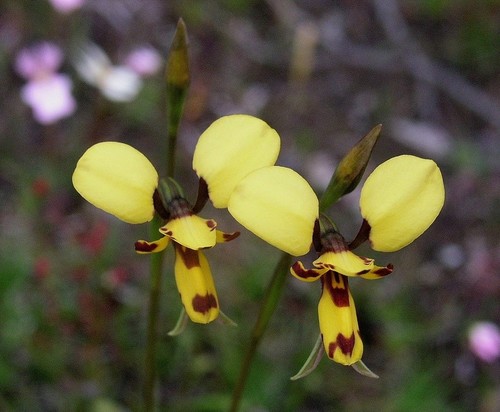
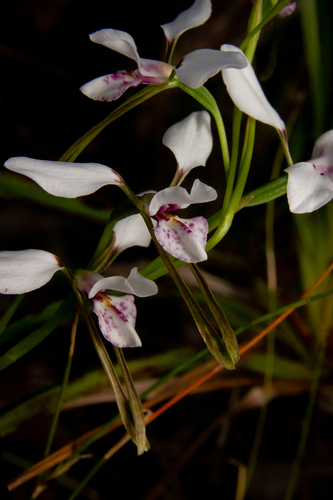
Diuris alba R.Br. is a tuberous, perennial herb that typically reaches a height of 150–400 mm (6–20 in). Up to three linear leaves grow from the base of the plant; each leaf is 100–300 mm (4–10 in) long, 2–3 mm (0.08–0.1 in) wide, and rolled so its sides face each other. Between two and seven white flowers marked with lilac or purple are arranged on a flowering stem, and each flower is about 20 mm (0.8 in) wide. The dorsal sepal is egg-shaped, 8–17 mm (0.3–0.7 in) long and 5–9 mm (0.2–0.4 in) wide, with downward-turned margins. The lateral sepals are linear to lance-shaped, 20–40 mm (0.8–2 in) long and 2–3 mm (0.08–0.1 in) wide; they turn downward, and are either parallel to each other or crossed. The petals are erect, ear-shaped structures positioned above the flower, 10–22 mm (0.4–0.9 in) long and 4–8 mm (0.2–0.3 in) wide, with a dark-colored, stalk-like "claw" that is 4–6 mm (0.16–0.24 in) long. The labellum is 10–14 mm (0.4–0.6 in) long and divided into three lobes. The central lobe is broadly egg-shaped to almost circular, 7–11 mm (0.3–0.4 in) wide, with a raised midline. The lateral lobes are linear to lance-shaped with the narrow end toward the plant's base, 3–4 mm (0.1–0.2 in) long and 1–2 mm (0.04–0.08 in) wide. There are also two broad calli that are 5–6 mm (0.20–0.24 in) long. Flowering takes place from August to November. This species, commonly called the white donkey orchid, is distributed across the coast and adjacent ranges of New South Wales and Queensland, from the Central Coast of New South Wales northwards. It grows alongside grasses in forest habitats.