About Diomedea epomophora Lesson, 1825
Nomenclature
This species is commonly known as the southern royal albatross, with the scientific name Diomedea epomophora Lesson, 1825.
Adult Body Length and Mean Weight
Adults have a body length ranging from 112 to 123 cm (44–48 in), and an overall mean weight of 8.5 kg (19 lb).
Campbell Island Sex-Specific Mass
For a sample at Campbell Island, 11 males had a mean mass of 10.3 kg (23 lb), and 7 females had a mean mass of 7.7 kg (17 lb).
Weight Comparison to Wandering Albatross
On average, this species may be heavier than most colonies of wandering albatross. Males are typically 2 to 3 kg (4.4 to 6.6 lb) heavier than females.
Wingspan Measurements
Reported average wingspans fall between 2.9 to 3.28 m (9.5 to 10.8 ft), with an upper maximum of around 3.50 m (11.5 ft).
Size Comparison to Wandering Albatross
The wandering albatross can exceed the southern royal albatross in maximum size, and averages slightly larger in linear dimensions even if not in bulk. The two species are close enough in physical dimensions that size alone cannot be used to tell them apart.
Juvenile Plumage
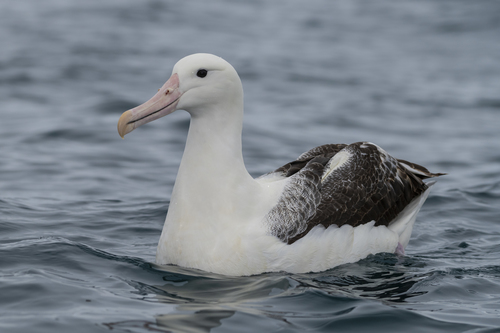
Juvenile southern royal albatrosses have white heads, necks, upper mantles, rumps, and underparts. Their mantles have black speckles, and their wings are dark brown or black with white flecks on the coverts. Both the tail and under-wing are white except for a black tip.
Immature Plumage Development
Young birds quickly lose the black coloration on their tails and backs. White plumage appears gradually on the upperwing, starting as speckles from the wing's leading edge.
Common Morphological Features
Individuals of all ages have a pink bill with black along the cutting edge of the upper mandible, and flesh-coloured legs.
Confusion with Northern Royal Albatross
Young birds with fully dark upperwings can be difficult to distinguish from the northern royal albatross.
Plumage Differences from Wandering Albatross
There are clear but subtle differences between the southern royal albatross and the wandering albatross: the southern royal albatross has a clean black and white appearance, and lacks the peach neck spot that is often found on wandering albatrosses. Most wandering albatrosses have dark feathers on the tail and crown, while white plumage in southern royal albatrosses expands starting from the middle of the wing in large blotches.
Bill Differences from Wandering Albatross
The southern royal albatross also has a slightly paler bill, with the dark cutting edge running along the middle of the bill.
Lifespan
This species has an average lifespan of 58 years.
Oceanic Range
Most of the southern royal albatross population lives between 30° S and 45° S. They range across the southern oceans, concentrating off the west and east coasts of southern South America, and in the waters surrounding New Zealand.
Campbell Island Breeding Population
The majority of the global southern royal albatross population nests on the rat-free subantarctic Campbell Island, where there are around 8,200 to 8,600 breeding pairs.
Smaller Breeding Colonies
Smaller colonies exist on Adams Island and Auckland Island in the Auckland Islands, with 20 breeding pairs combined across these two islands, and 69 breeding pairs on Enderby Island.
2017 Enderby Island Breeding Count
Direct counts done by helicopter and on foot on Enderby Island in January 2017 estimated there were 47 breeding pairs at this site.
Hybrid Occurrence
Some hybrids between northern royal albatross (Diomedea epomophora sanfordi) and southern royal albatross (D. e. epomophora) can be found at the northern royal albatross colony on New Zealand's Otago Peninsula.