About Desmognathus organi Crespi, Browne & Rissler, 2010
Size
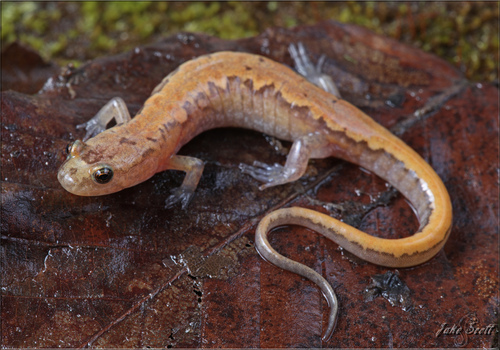
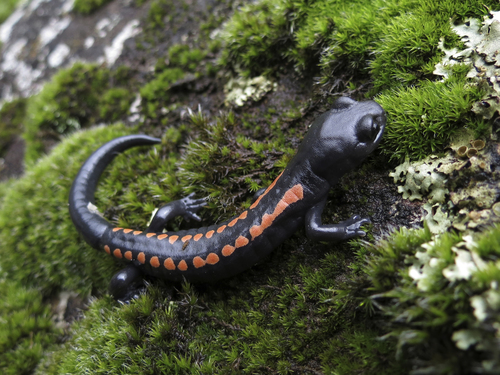
Desmognathus organi can be identified by its small size, with an average total length of only 40–60 mm.
Dorsal Pattern & Eyelid Traits
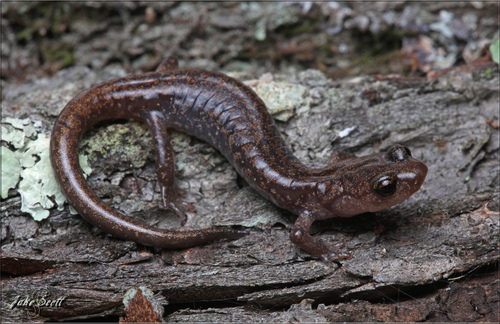
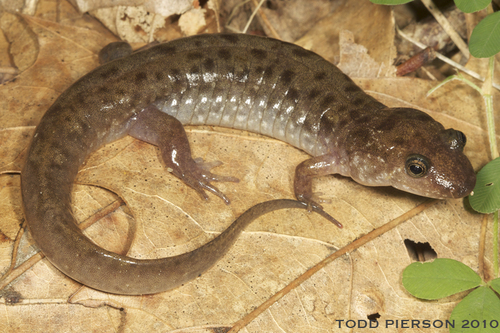
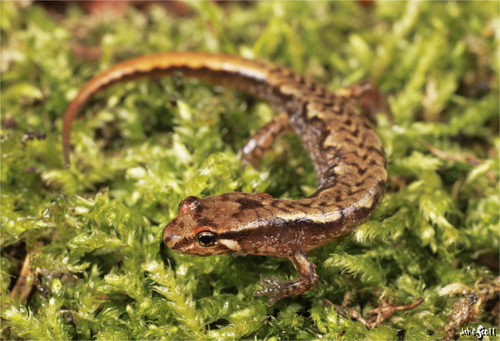
It has a distinct herringbone pattern on its dorsal side and copper-colored eyelids, traits that are only shared with Desmognathus wrighti.
Coloration
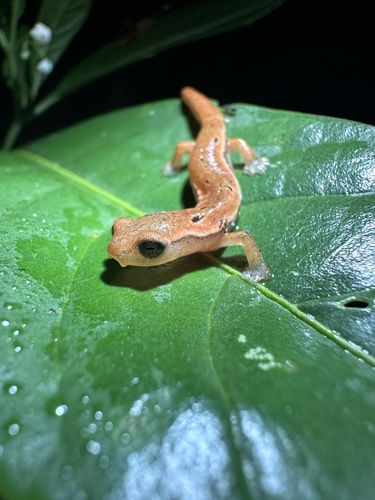
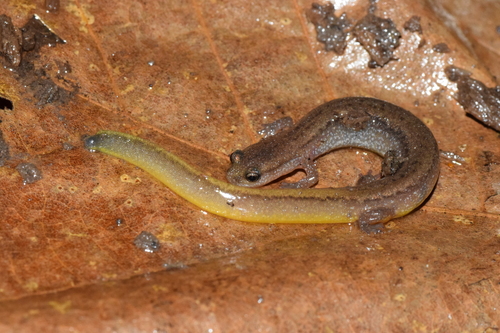
Its dorsal coloration ranges from dark reddish-brown to light brown, and its ventral surface is much lighter than the back.
Genus-Characteristic Morphology
Like other species in the Desmognathus genus, it has a light-colored eye stripe that extends to the jaw, and its hindlimbs are longer and more robust than its forelimbs.
Tail Morphology
Unlike most other Desmognathus species, the tail of D. organi is round in cross section and makes up less than half of the salamander’s total length.
Interspecific Tail Trait Comparison
This tail trait is characteristic of smaller Desmognathus species, including D. wrighti (the southern pygmy salamander) and D. aeneus (the seepage salamander).
Size Comparison with D. wrighti
Compared to D. wrighti, D. organi is generally slightly larger: the maximum total length of an adult D. wrighti is 50 mm, while most adult D. organi exceed 50 mm.
Head Width Comparison with D. wrighti
D. organi also has wider heads than D. wrighti.
Sexual Dimorphism
In D. organi, females tend to be larger than males, and this sexual dimorphism is not present in D. wrighti.
Habitat
Populations of Desmognathus organi live in high-elevation spruce-fir and hardwood forest habitats in the Blue Ridge Mountains.
Elevation Range
The species is rarely found at elevations below 1500m.
Historical Distribution Context
It is thought that historically, the distribution of spruce-fir forests and the populations of pygmy salamanders they supported were once continuous.
Population Isolation Cause
As the climate became warmer and drier, these populations became isolated on the high-elevation "islands" that exist today.
Current Species Range
D. organi occurs north and east of the French Broad River, ranging from the southwesternmost part of Virginia (specifically Mount Rogers and Whitetop Mountain) to the mountain ridges of western North Carolina and eastern Tennessee.
Sister Species Distribution
Its sister species, D. wrighti, lives at similar elevations and in similar habitats south and west of the French Broad River, extending to the Georgia state line.