About Desmodium marilandicum (L.) DC.
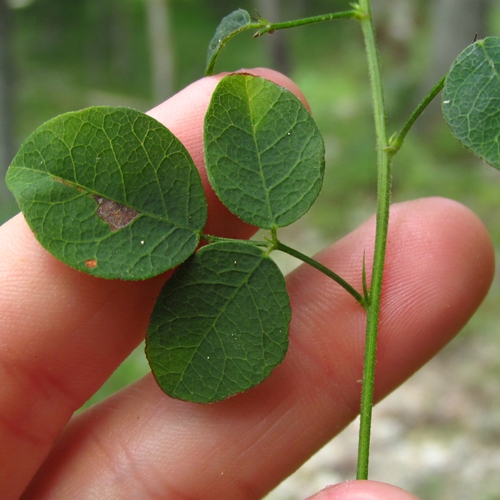
Desmodium marilandicum (L.) DC. is an erect perennial plant that typically grows 60 to 150 cm tall. Its stems are either smooth or sparsely covered with fine, hooked or soft hairs, and are never densely hairy. The leaves are compound and arranged alternately along the stem, with smooth entire margins. Terminal leaflets of this species can be ovate to nearly round, or oblong to elliptic. They measure 1 to 2.5 cm in length, occasionally reaching up to 5 cm, and are typically about 1.6 to 2.2 times as long as they are wide. Both sides of the leaflets range from smooth to moderately hairy; hairs are also especially present on the flower's calyx lobes. The plant produces blue to purple bilaterally symmetric flowers. Each flower has four or five petals fused into a cup or tube, and individual flowers are typically 4 to 6 mm long. The ten stamens are diadelphous, meaning they are arranged in two groups. The fruit is a dry loment, which does not split open when ripe. It consists of 1 to 3 weakly obovate segments, each 3.5 to 5.5 mm long and 3 to 4 mm wide. The fruit's stipe is 1.5 to 2.5 mm long, roughly equal to or shorter than the calyx and usually shorter than the remaining stamens. Desmodium marilandicum is distributed from Massachusetts west to Michigan and Missouri, and south to the northern Florida panhandle and Texas. It grows in fields, along woodland borders, and in disturbed areas.