About Daviesia acicularis Sm.
Taxon Naming and Growth Habit
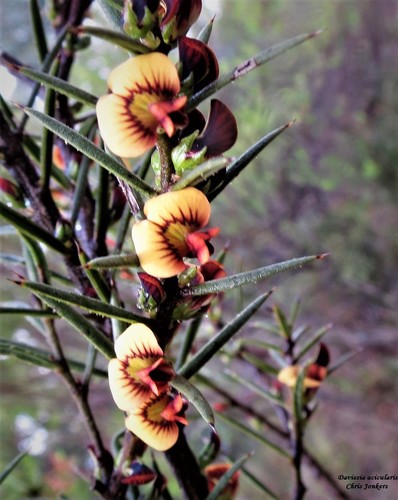
Daviesia acicularis Sm. is a wiry shrub that typically grows up to 1 metre (3 feet 3 inches) in height, and has hairy foliage.
Phyllode Shape and Dimensions
Its phyllodes are tapering linear to narrow elliptic, 10–65 mm (0.39–2.56 in) long and 0.5–10 mm (0.020–0.394 in) wide.
Phyllode Surface Features
The edges of the phyllodes are curved downwards or rolled under, and a prominent mid-vein is visible on the upper surface.
Flower Arrangement and Size
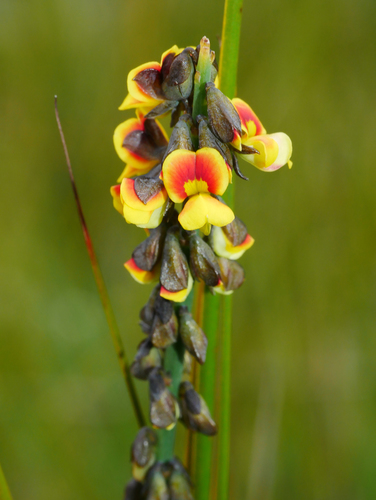
The individual flowers are 5–7 mm (0.20–0.28 in) long, arranged singly on a 1–2 mm (0.039–0.079 in) long peduncle.
Sepal Characteristics
The sepals are 3.5–4.5 mm (0.14–0.18 in) long and joined at the base.
Petal Coloration and Size
The standard petal is yellow to orange with dark red markings, and measures 5–7 mm (0.20–0.28 in) long; the keel is dark red that grades to pink near its base.
Flowering Period
Flowering occurs from August in the northern part of the range to October in the southern part.
Fruit Characteristics
The fruit is a triangular pod 6–9 mm (0.24–0.35 in) long.
Habitat and Distribution
This species of pea grows in forest and hummock grassland, across a range extending from Tambo and Charleville in central Queensland to Eden on the coast of New South Wales, and inland in New South Wales as far as Cowra, West Wyalong and Enngonia.