About Desmodium incanum (Sw.) DC.
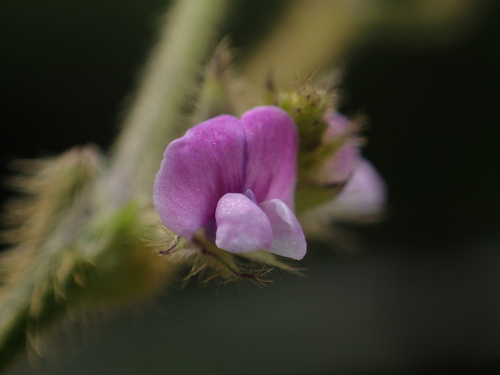
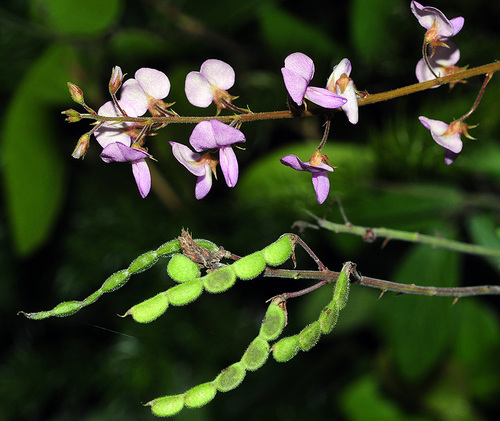
Many older sources incorrectly label Desmodium laxiflorum as Desmodium incanum. Desmodium incanum, commonly called creeping beggarweed, Spanish clover, Spanish tick-trefoil, or hitchhikers, is a perennial plant native to Central and South America. In Hawaiʻi, it is called kaʻimi or kaimi clover, a name derived from the Hawaiian word meaning "seeker". It was originally introduced around the world as a forage crop, and has since spread to many regions, though it is no longer an important fodder crop. It is classified as a weed both in its native range and areas where it has been introduced. It has spread through Florida, across the southern United States into southern Texas, and across many Pacific islands including Hawaiʻi. This plant reproduces using branched runners. It has hairy, elliptic-shaped leaves, and its flowers range in color from pink to rose. Its seedpods are a particularly frustrating agricultural issue: when ripe, they break off easily from the plant, and are covered in sticky hairs called trichomes that cling to any rough surface such as skin, animal fur, and clothing, which helps the plant spread. D. incanum is valued for its ability to fix nitrogen and increase soil fertility, so it is commonly grown as an intercrop. There has been long-standing confusion around this species' correct scientific name: it was long referred to as Desmodium canum, and for a considerable period, the name D. incanum was incorrectly applied to the species now called Desmodium laxiflorum. In West Africa, a blue dye is obtained from Desmodium incanum.