About Dendropsophus marmoratus (Laurenti, 1768)
Identification
Size
Dendropsophus marmoratus is a medium-sized frog. Average snout–vent length is 35.8 mm (range 29.8–41.5 mm) for males, and 47.7 mm (range 46.5–49.7 mm) for females.
Head Features
As documented by Duellman, the snout is round when viewed from above and in profile. Eardrums are present.
Limb Webbing
The outermost hand finger has webbing reaching the base of the disc, while the other hand fingers have webbing along roughly two-thirds of their length. Toes also have webbing extending to the base of their discs.
Secondary Sexual Traits
Breeding males do not have cornified nuptial excrescences.
Skin Characteristics
Scalloped skin folds are present along the outer edges of the feet, forearms, and hands. The dorsal skin is weakly tuberculated, and the ventral belly skin is granular.
Dorsal Coloration
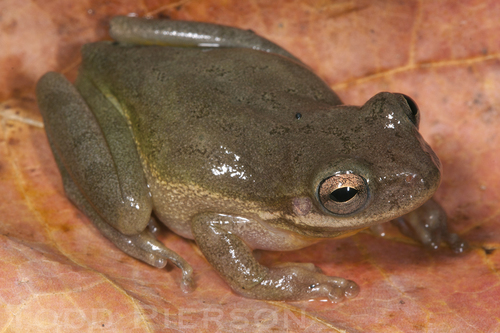
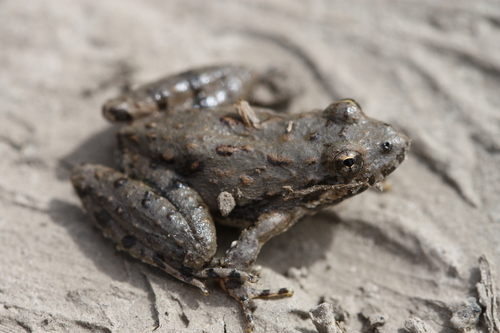
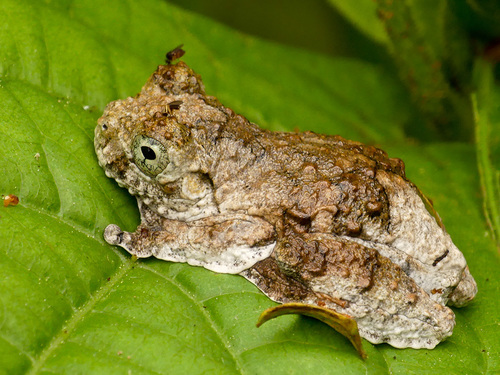
The back ranges from greyish-bronze to greenish-bronze, and is marked with black, dark brown, or reddish mottling that usually includes olive-green areas along the dorsolateral sides. Most individuals have paired large brown or reddish marks on the scapular region.
Limb Coloration
The armpit, groin, and posterior thigh surface are yellow-orange; the thighs have black spots or mottling. The anterior thigh surfaces are pale yellow-green with small black dots.
Ventral Coloration
The chin and belly are white or light yellow with black dots, while the ventral surfaces of the limbs are dark gray to black.
Additional Color Features
Webbing is orange on the distal portion and black on the proximal portion. The iris is pale gray with fine black reticulations.
Distinguishing Trait
No closely related species that occurs alongside Dendropsophus marmoratus shares this unique color pattern, making it easily distinguishable from other sympatric species.
Habitat and distribution
General Habitat Type
Dendropsophus marmoratus is an arboreal forest-dwelling species, but individuals migrate to open-area breeding sites.
Ecuador Site Records
Around two-thirds of recorded individuals at Santa Cecilia, Sucumbíos Province, Ecuador, were found near temporary pools and water-filled ditches in clearings adjacent to forest. A smaller number of individuals were located on tree branches in secondary and primary forest.
Canopy Occurrence
At Lago Agrio, frogs were recorded on fallen tree branches in primary forest. Many recorded individuals were found at heights over 20 m above ground.
Yasuni National Park Records
In Yasuni National Park, Ron recorded the species in open areas, and Read's field notes documented calling choirs of Dendropsophus marmoratus in recently formed temporary pools alongside roads in both primary and secondary forest.
Preferred Breeding Sites
The species is especially common in large water-containing clearings within primary forest, such as oil well platforms. Males of Scinax ruber also call alongside these choirs.
Altitude and Range
Dendropsophus marmoratus occurs at altitudes between 0 and 1000 m above sea level across the Amazon Basin, in Bolivia, Brazil, Colombia, Ecuador, French Guiana, Guyana, Peru, Suriname, and southern Venezuela.
Pet Trade Status
Use in the pet trade: In the exotic pet trade, individual Dendropsophus marmoratus have become popular for their color patterns. Many people compare the frog's mottled appearance to bird feces, which led to the common name "South American bird poop frog".