About Delphinium tricorne Michx.
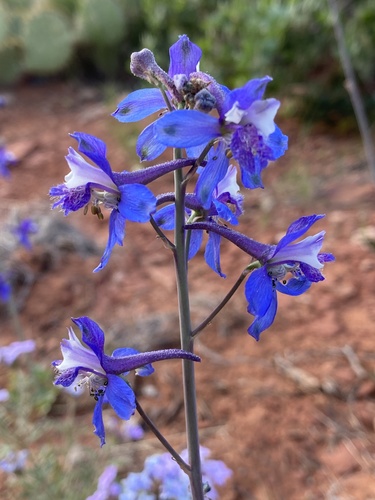
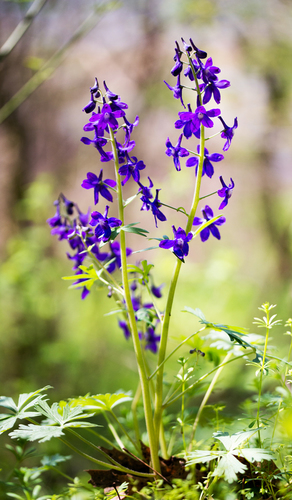
Delphinium tricorne Michx., commonly referred to as D. tricorne, is a perennial herb that reaches a height of 15–45 centimeters (6–18 inches). A thin flowering stalk grows from a cluster of basal leaves, with a small number of alternate leaves growing along the stalk itself. All leaves range in color from grayish green to green, and are deeply split into roughly 5 primary lobes; each primary lobe divides further into 2 or 3 smaller secondary lobes. Basal leaves can grow up to 10 centimeters (4 inches) in both length and width. The inflorescence is a raceme at the tip of the stalk, holding 6 to 24 flowers that can be violet, blue, white, or a mix of these colors. Flowers have 4 to 5 sepals and a long, narrow spur at the back, and measure 3–4 centimeters (1–1.5 inches) long. Flowering occurs from March to May. This species is native to parts of the central and eastern United States, with a range extending from eastern Nebraska in the west to southwestern Pennsylvania in the east, Minnesota in the north, and the Carolinas, Georgia, and eastern Oklahoma in the south. It grows in rich mesic forests and moist prairies, most often over calcareous or mafic rocks, and less commonly over very fertile alluvium deposits. Bumblebees and hummingbirds pollinate D. tricorne, and multiple other bee species also visit its flowers to collect nectar and pollen. Two diterpenoid alkaloids, lycoctonine and tricornine (also called lycoctonine-18-O-acetate), have been isolated from this plant. The toxicology and pharmacology of lycoctonine are relatively well researched, but only limited information exists about the biological properties of tricornine. Both alkaloids have neuromuscular blocking effects, so Delphinium tricorne should be considered a potentially poisonous plant. It has been recognized as poisonous to livestock for a long time.