About Delonix regia (Bojer ex Hook.) Raf.
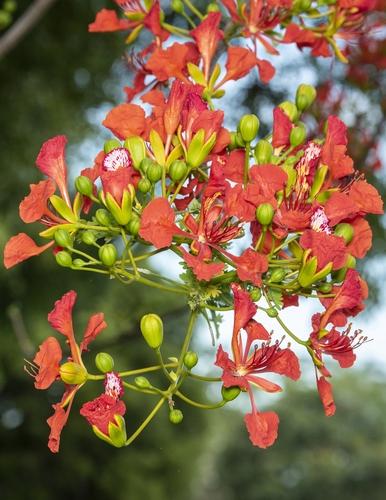
Delonix regia (Bojer ex Hook.) Raf. is a medium-sized deciduous tree that typically reaches around 10 m (33 ft) in height, with a maximum recorded height of 12 m (40 ft). Its light brown bark is often creased at branches and has prominent lenticels. This tree has doubly pinnate compound leaves that have a feathery appearance and a characteristic light, bright green color when new. Each full leaf is 30–50 cm (12–20 in) long, and holds 20 to 40 pairs of primary leaflets called pinnae. Each pinna carries 10–20 pairs of secondary leaflets called pinnules; other sources count 8–25 or more pairs of pinnae per leaf, each lined with 30–60 or more opposite leaflets. Individual leaflets are oblong, 4–12 mm long, dark green with a dull upper surface and a paler, greyish lower surface. The large flowers grow in corymbs along and at the ends of branches. Most flowers have four spreading scarlet or orange-red petals that make the blossom up to 8–11 cm (3–4 in) across, plus a fifth slightly larger upright petal called the standard, which is spotted with yellow and white. A naturally occurring variety, flavida (known as Radhachura in Bengali), produces yellow flowers. Young pods are green and flaccid, and mature to become dark brown and woody. Mature pods can grow up to 60 cm (24 in) long and 5 cm (2 in) wide, and remain on the tree for many months. The seeds are small, averaging around 0.4 grams (6.2 grains) in weight. Pollen grains of Delonix regia are elongated, approximately 52 μm in size. In India, this species is leafless during the winter months of December to February; new leaves begin growing in March to April, flowers start appearing in April, and reach full bloom in May, with fruit pods persisting for many months. In regions with a distinct dry season, Delonix regia sheds its leaves during drought, while it is virtually evergreen in areas without a strong dry season. Delonix regia is endemic to Madagascar's dry deciduous forests, and is classified as endangered in its wild habitat. It has been widely introduced to tropical and sub-tropical regions around the world, and is widely cultivated and regarded as naturalized in many locations where it is grown. In addition to its ornamental value, it is grown as a useful shade tree in tropical climates: it usually stays at a modest height (most often 5 m or 15 ft) but spreads widely, and its dense foliage creates full shade.