About Daviesia wyattiana F.M.Bailey
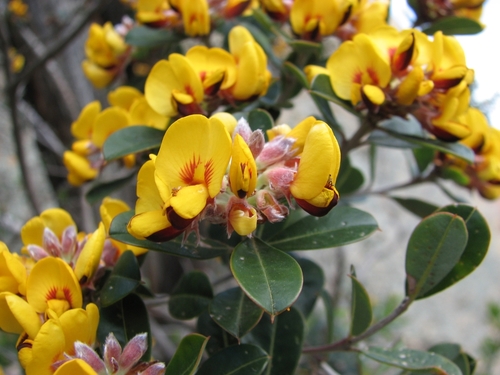
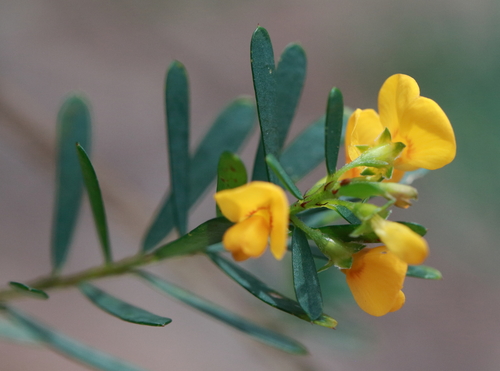
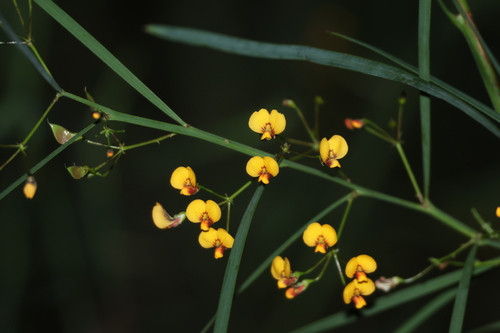
Daviesia wyattiana, commonly known as long-leaf bitter-pea, is a sparse, erect shrub that typically reaches a height of 1 to 2.5 metres (3 feet 3 inches to 8 feet 2 inches), and has hairless foliage. Its branchlets are triangular in cross-section, measuring 1.5 to 3 millimetres (0.059 to 0.118 inches) wide, and its phyllodes are linear, 40 to 220 millimetres (1.6 to 8.7 inches) long and 2 to 8 millimetres (0.079 to 0.315 inches) wide with a prominent mid-vein. Flowers are arranged in groups of four to seven. These groups form on a peduncle 7 to 28 millimetres (0.28 to 1.10 inches) long, and individual flowers grow on pedicels 5 to 15 millimetres (0.20 to 0.59 inches) long. The sepals are 3.5 to 4.5 millimetres (0.14 to 0.18 inches) long, joined at the base, and have more or less equal lobes. The standard petal is broadly egg-shaped, about 7 millimetres (0.28 inches) long and 8 millimetres (0.31 inches) wide, and is yellow to orange with red or purplish markings. The wings are yellow with a red base, 5 to 6.5 millimetres (0.20 to 0.26 inches) long. The keel is light red and 4.5 to 5.0 millimetres (0.18 to 0.20 inches) long. Flowering occurs between August and November, and the fruit is a triangular pod 7 to 10 millimetres (0.28 to 0.39 inches) long. Long-leaf bitter-pea usually grows in forest on rocky ridges. Its distribution extends from the central ranges of Queensland to near Coffs Harbour, with a separate disjunct population ranging from the Budawangs in southern New South Wales to far eastern Victoria.