About Daviesia nudiflora Meisn.
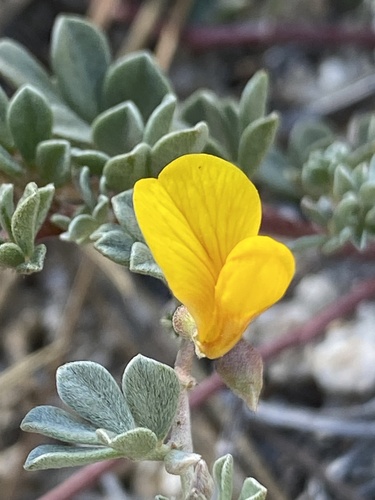
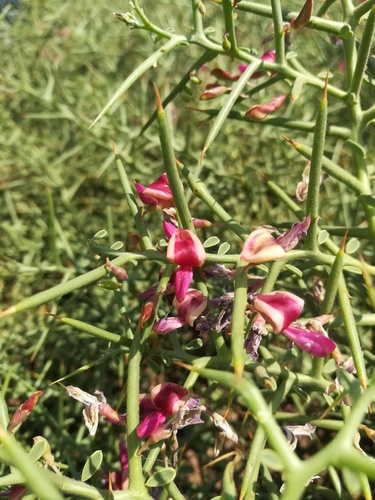
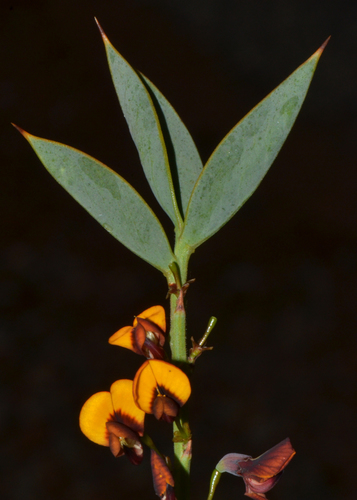
Daviesia nudiflora Meisn. is a bushy shrub that usually reaches a height of 0.3 to 2.5 meters, and has branchlets that are more or less angular or ridged. Its phyllodes are sharply pointed, ranging in shape from egg-shaped to elliptic or oblong, 4–50 mm long and 2–18 mm wide. Near the base of the plant, phyllodes are sometimes scale-like and only 1–4 mm long. Flowers are arranged singly or in pairs in leaf axils, growing on a peduncle 0.5–2 mm long, with a pedicel 2–7 mm long and bracts at the base of the peduncle. The sepals are 3.0–4.5 mm long and joined at their base; the two upper sepals lobes are joined for most of their length, while the lower three lobes are broadly triangular and about 1 mm long. The standard petal is egg-shaped or elliptic, about 7–12 mm long and 7–11 mm wide, and is yellow-orange with a red to brown base. The wings are 7–10 mm long and red, and the keel is 6–10 mm long and also red. Flowering takes place from May to September, and the fruit is a slightly flattened triangular pod 10–14 mm long. This species of Daviesia grows in mallee-heath with a shrubby understorey. It is widespread across the northern half of the wheatbelt, ranging from near Kalbarri to near Lake Grace, with isolated disjunct populations near Bunbury and Southern Cross. Subspecies amplectens is restricted to the area from near Cadoux to near Dowerin. Subspecies drummondii occurs between Ballidu, York and Corrigin. Subspecies hirtella is found between Kalbarri, Regans Ford and Corrigin. Subspecies nudiflora has roughly the same overall distribution as the full species, occurring in the Avon Wheatbelt, Coolgardie, Geraldton Sandplains, Jarrah Forest, Mallee and Swan Coastal Plain biogeographic regions of south-western Western Australia.