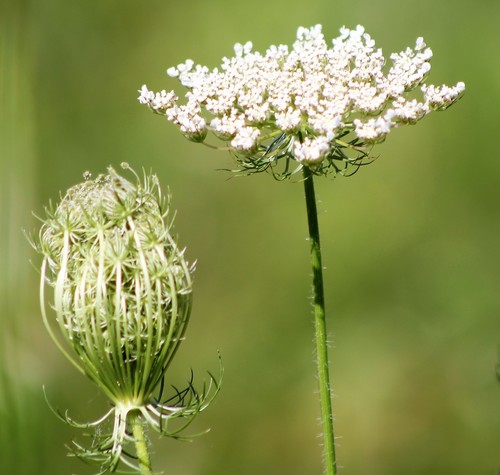
About Daucus carota L.
Taxonomy and Nomenclature
Daucus carota L., commonly known as wild carrot, is a herbaceous, somewhat variable biennial plant.
Height
It typically grows 30–100 cm (1–3 ft) tall, and rarely reaches up to 120 cm (4 ft) in height.
Stem Characteristics
The plant is roughly hairy, with a stiff, solid stem.
Leaf Structure
Its leaves are tripinnate, finely divided into thin segments, lacy in texture, and overall triangular in shape.
Leaf Dimensions and Arrangement
They measure 5–15 cm (2–6 in) long, are bristly, arranged alternately in a pinnate pattern.
Inflorescence Dimensions
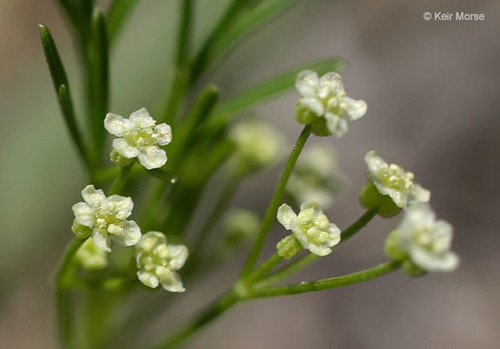
The small flowers are dull white, clustered into flat, dense terminal umbels that are about 8–15 cm (3–6 in) wide.
Flower Coloration
Flower buds may be pink, and the centre of the umbel often holds one (rarely a few) pink, reddish, or purple central flower called the "ruby".
Distinguishing Bract Feature
There are 7–13 three-forked or pinnate bracts below the umbel, a feature that separates this plant from other white-flowered umbellifers.
Umbel Post-Flowering Morphology
As seeds develop, the edges of the umbel curl inward, the cluster becomes more congested, and it develops a concave surface.
Fruit Structure
The fruit is a small, dry, bumpy, oval and flattened carpel 2.5–4 mm long, with short styles, hooked spines, and protective surrounding hairs.
Fruit Development
It is bicarpellate, made up of two mericarps, and its endosperm develops before the embryo.
Dispersal Mechanism
Dried umbels can detach from the parent plant, and have been noted to have characteristics similar to tumbleweeds.
Central Red Flower Function
The central red flower gets its colour from anthocyanin, and its function is to attract pollinating insects.
Flowering Period
Wild carrot mainly flowers from June to August, and rarely flowers in May or September.
Poison Hemlock Resemblance
D. carota resembles the highly toxic poison hemlock in appearance, but can be easily distinguished by its combination of tripinnate leaves, fine hairs covering its solid green stems and leaves, a root that smells like carrot, and often a single central red flower in its umbel.
Poison Hemlock Stem Traits
Poison hemlock stems have purple mottling and lack the hairiness found on the plain green stems of wild carrot.
Poison Hemlock Odor Trait
A further distinguishing feature is the unpleasant mouse urine-like odour of crushed poison hemlock leaves.
Native Distribution
Daucus carota is native to temperate regions of Europe, northern Africa (extending south to Ethiopia), and southwestern and eastern Asia.
Introduced Range
It has been introduced to and naturalized in North America, South America, Australia, New Zealand, and South Africa.
Habitat Preferences
It is most commonly found growing in meadows, along roadsides, and in unused fields, and grows best in full sun to partial shade.
Phytophotodermatitis Risk
Like many other species in the Apiaceae family, wild carrot leaves may cause phytophotodermatitis.
Handling Caution
Skin contact with the foliage, especially wet foliage, can trigger skin irritation in some people, so caution is recommended when handling the plant.
Equine Adverse Effects
It may also cause a mild adverse effect in horses.
Falcarinol Function
The compound falcarinol occurs naturally in Daucus carota to protect the plant against fungal diseases.
Falcarinol Toxicity Testing
Laboratory testing shows this compound is toxic to mice and the water flea Daphnia magna.
Human Consumption Safety
Normal consumption of carrots has no toxic effect in humans.
Root Edibility
Like the closely related cultivated carrot, the wild carrot root is edible when young, but quickly becomes too woody to eat.
Edible Plant Parts
Wild carrot flowers are sometimes battered and fried, and both the leaves and seeds are also edible.
Traditional Medicinal Uses
For centuries, the seeds and flowers have been used as contraception and as an abortifacient, but no scientific research has confirmed these effects, and there is no evidence confirming that this use is safe.
Dyestuff Use
When used as a dyestuff, the flowers produce a creamy, off-white colour.