About Dasyurus viverrinus (Shaw, 1800)
General Size Comparison
Eastern quolls (Dasyurus viverrinus) are roughly the size of a small domestic cat.
Adult Male Dimensions
Adult males have a total length of 53 to 66 cm (21 to 26 in), which includes a 20 to 28 cm (7.9 to 11.0 in) tail, and average 1.1 kg (2.4 lb) in weight.
Adult Female Dimensions
Females are noticeably smaller: their total length is 48 to 58 cm (19 to 23 in), including a 17 to 24 cm (6.7 to 9.4 in) tail, and they weigh approximately 0.7 kg (1.5 lb).
Head and Limb Morphology
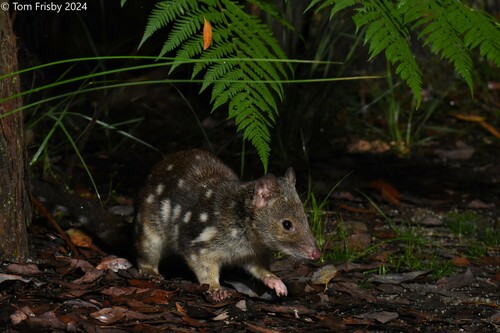
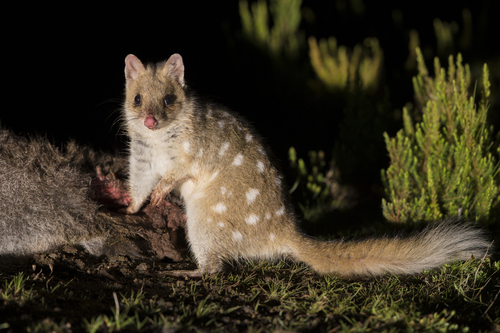
Eastern quolls have a tapering snout, short legs, and erect ears.
Hind Foot Distinguishing Trait
They can be told apart from all other quoll species by having only four toes on their hind feet instead of five; they lack the hallux.
Upper Coat Characteristics
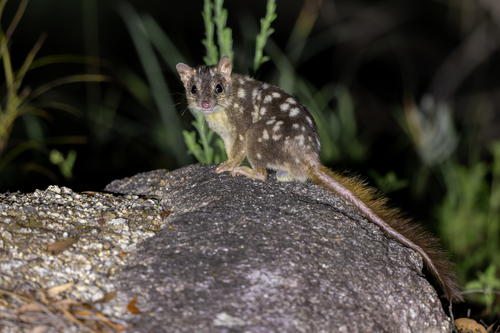
Their coat is thick, and ranges in color from light fawn to near-black, and is covered in white spots.
Underpart Characteristics
Their underparts are off-white, and run from the chin to the underside of the tail.
Litter Color Variation
Both fawn and black individuals can be born in the same litter.
Current Population Color Ratios
In currently surviving populations, fawn-colored individuals are around three times more common than black ones.
Spot Size and Placement
The spots measure 5 to 20 mm (0.20 to 0.79 in) in diameter, and cover the upper body and flanks from the top of the head to the rump.
Tail Spotting Trait
Unlike some other quoll species, the spots do not extend onto the tail.
Female Pouch Structure
Females have a relatively shallow fur-lined pouch formed by lateral folds of skin.
Breeding Season Pouch Changes
The pouch grows larger during breeding season, and contains six to eight teats.
Teat Functionality Cycle
Teats only become elongated and functional if a young quoll attaches to them, and they shrink back after the young leave the pouch.
Male Reproductive Morphology
Like all quolls, the male eastern quoll's penis has an unusual fleshy appendage.
Large Intestine Structure
The large intestine of the eastern quoll is relatively simple: it has no caecum, and is not divided into a colon and rectum.
Newborn Heart Trait
One unusual trait in eastern quolls is that newborn young have an opening connecting the ventricles of the heart, in addition to the opening connecting the atria that all marsupials have.
Neonatal Heart Opening Closure
Both openings close within a few days after birth.
Biofluorescence Trait
Eastern quolls are biofluorescent under ultraviolet light.
Wild Biofluorescence Documentation
This biofluorescence was first photographed in the wild in 2025.
Historical Mainland Distribution
Historically, the eastern quoll ranged across most of southeastern mainland Australia, from the eastern coasts of South Australia, through most of Victoria, to the mid-north coast of New South Wales.
Historical South Australia Population
The species was once common around Adelaide, especially in the Adelaide Hills.
Early Adelaide Region Decline
A 1923 newspaper article noted that the species had declined rapidly and was presumed extinct in the area over the ten years before that date.
Mainland Extinction Timeline
The species likely became functionally extinct across its entire mainland range by the early 1960s.
Current Surviving Range
Today it remains widespread but patchily distributed in Tasmania and Bruny Island.
Tasmanian Habitat Range
In Tasmania, eastern quolls live in rainforest, heathland, alpine areas, and scrub below 1,500 m (4,900 ft).
Preferred Habitat Types
They prefer dry grassland and forest mosaics bordered by agricultural land, particularly in areas where pasture grubs are common.
Breeding Season Timing
Eastern quolls' breeding season starts in early winter.
Oestrus and Mating Pattern
Their oestrus cycle lasts 34 days, though most individuals mate during their first cycle of the year.
Gestation and Litter Size
After a gestation period of 19 to 24 days, females give birth to as many as thirty young.
Juvenile Survival Mechanism
Only the first young to attach to available teats survive.
Teat Attachment Period
Young eastern quolls stay attached to the teat for 60 to 65 days.
Juvenile Development Milestones
They begin developing fur at around 51 days old, open their eyes at about 79 days old, and are fully weaned at 150 to 165 days old.
Maturity and Lifespan
They reach sexual maturity in their first year, typically live 2–3 years, and can live up to 7 years in captivity.