About Daphne laureola L.
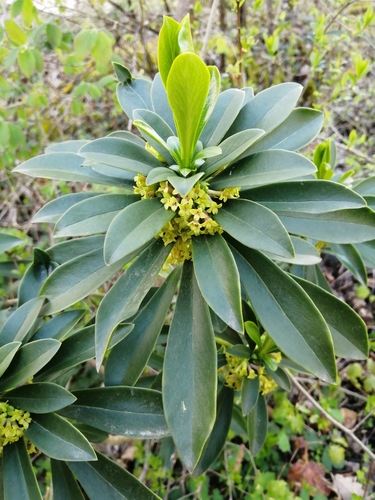
Daphne laureola L. is a shrub that typically reaches 0.5 to 1 metre (2 to 3 ft) in height, and rarely grows as tall as 1.5 m. Its growth habit can be either upright or decumbent, meaning it arches at the base before spreading upward. Mature bark is thin and yellow-grey, while young immature stems are green. Its leaves are arranged in a spiral pattern, usually forming dense whorls at the tips of shoots, though they may also grow along the full length of shoots. Leaves have an oblanceolate to obovate-oblanceolate shape, measuring 5 to 12 centimetres (2 to 5 in) long and 1 to 3 cm wide. They are glabrous (hairless), dark green and glossy on the upper surface, and a lighter green on the underside. The flowers are 8 to 12 mm long, inconspicuous, and yellow-green. They have four sepals and no petals, carry a honey scent, and grow in small axial racemes that are mostly hidden among the leaf bases. Flowering occurs in late winter and early spring, and pollination is carried out by flies and moths. This species is outcrossing, so seed production requires multiple individual plants to be present. The fruit is a black, egg-shaped berry 1.5 cm (1⁄2 in) wide that holds one seed. The berries ripen in late summer; they are poisonous to humans, but not toxic to birds, which eat the berries and disperse the plant's seeds. In terms of ecology and habitat, Daphne laureola is one of two Daphne species native to Great Britain, with the other being Daphne mezereum. Both species strongly prefer alkaline soils and are most commonly found in limestone areas, though D. laureola can also grow on clay. Unlike D. mezereum, D. laureola is evergreen, produces yellowish-green flowers very early in spring, and bears black berries. Regarding toxicity, all parts of Daphne laureola, including its fruit, are poisonous to humans. Contact with the plant's sap is known to cause skin rashes.