About Dactyloptena orientalis (Cuvier, 1829)
Size
The oriental flying gurnard, Dactyloptena orientalis, can reach a maximum total length of 40 cm (16 in), though its common adult size is around 20 cm (8 in).
Head Features
It has a broad head with a blunt snout and widely spaced eyes.
Body Armour
Its robust body is heavily covered in protective armoured plating.
Fin Structure
The dorsal fin is made up of seven spines and nine soft rays, while the anal fin has no spines and between six and seven soft rays.
Pectoral Fin Appearance
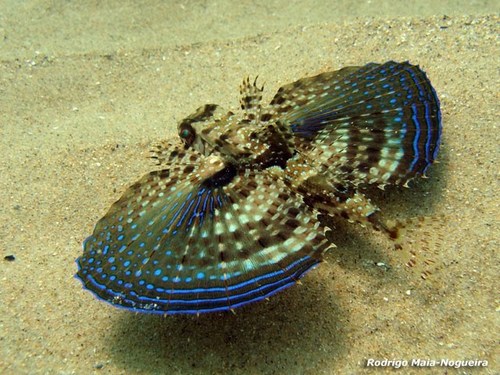
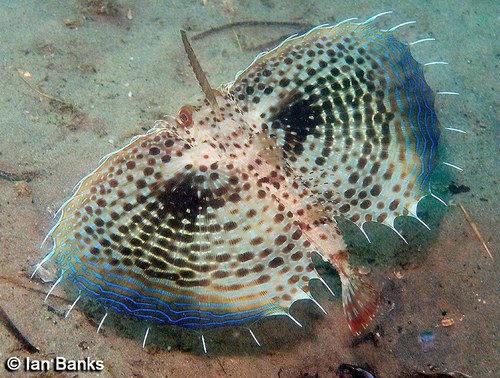
This species has very large, rounded pectoral fins marked with many dark spots and wavy streaks, edged with a bright blue border.
Pectoral Fin Rays
Each fin ray has a small, feeler-like extension at its tip.
Coloration
It is well camouflaged, with a grayish brown base color overlaid with dark brown or black markings across its head and body.
Distribution Range
The Oriental flying gurnard has a wide distribution across the tropical waters of the Indo-Pacific region, including the Red Sea.
Range Extent
Its range extends from the coasts of East Africa to Polynesia, and includes the western, northern, and eastern coasts of Australia.
Habitat
It lives on the seabed in bays, estuaries, and sandy areas.
Depth Range
It is most commonly found at depths of approximately 10 m (33 ft), but can occasionally be found as deep as 100 m (328 ft).