About Cytisus proliferus L.f.
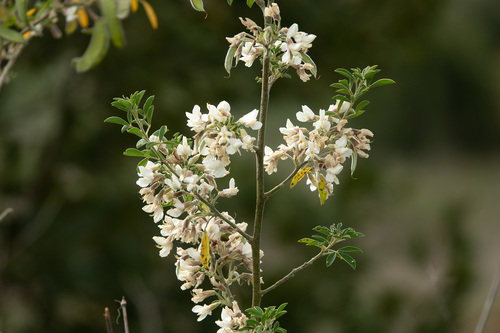
Tagasaste, with the scientific name Cytisus proliferus L.f., is an evergreen shrub. It has rough yellow-grey bark, and its young growth is velvety and hairy. Its leaves are made up of three equal-sized, greyish-green leaflets that are slightly paler on their underside. Scented, creamy-white flowers grow in small clusters in the leaf axils. It produces flat, pea-like pods that are green when young and ripen to black. Its seeds are tiny, with roughly 45,000 seeds per kilogram, and are shiny and black. Tagasaste is classified as a promiscuous legume, which is compatible with cowpea and Tagasaste 1502 Rhizobium, and it can form root nodules with a wide range of rhizobia. This shrub grows best in sandy, well-drained soils with a pH between 4 and 7. On deep, freely drained soils, its roots can reach at least 10 meters deep. Any physical or chemical barrier in the soil that limits root growth will lower tagasaste productivity and survival. Cultivars originating from arid sandy areas are very susceptible to root rot fungus when grown on poorly drained soils; the most common fungi causing this issue are Fusarium, Pythium, and Rhizoctonia. Tagasaste can tolerate winter temperatures as low as −9 °C, though some cultivars can survive winter temperatures down to −15 °C, as observed in Orange, Eastern Australia. Frost will burn tagasaste leaves, and seedlings can be killed at temperatures below 0 °C. Growth of mature tagasaste slows when winter temperatures drop below 20 °C. The shrub can tolerate maximum temperatures up to 50 °C, but when temperatures rise above 36 °C, its leaves close in response to stress. Tagasaste flowers during the early rainy season, which typically falls between June and October in Australia, New Zealand, and East Africa. Tagasaste has two distinct root types. It has a small number of large 'sinker' roots that can extend down to at least 10 meters; these roots access deep moisture during long dry summers. It also has many 'feeder' roots, which are mostly restricted to the top 1.5 meters of soil. Feeder roots can extend at least 15 meters out from the plant's trunk, and they take up mineral nutrients from the soil, as well as water during winter. In summer, deep soil water absorbed by sinker roots moves into the shallow feeder roots and is released into the surrounding shallow soil. This process, called 'hydraulic lift', allows tagasaste to continue extracting nutrients from shallow soil that would otherwise be too dry to support nutrient uptake. This same hydraulic lift trait has also been observed in native banksia shrubs that naturally grow on these soils and share a similar root structure. When tagasaste is planted in rows that run north to south, both shoots and roots grow twice as fast on the west side of the plant as they do on the east side.