About Cyrtodactylus deccanensis (Günther, 1864)
Species Nomenclature
This species, Cyrtodactylus deccanensis (Günther, 1864), has a rather large, oviform head.
Head Structure
Its snout is longer than the diameter of the orbit, or the distance between the eye and the ear-opening; the forehead and loreal region are concave. The ear-opening is suboval, vertical, and about one third the diameter of the eye.
Body Shape
The body is moderately elongate and depressed.
Limb and Digit Structure
Limbs are rather long, and digits are moderately elongate, cylindrical in the basal portion and compressed in the distal portion. The plates under the basal phalanx are very small, only slightly larger than the surrounding tubercles.
Head Scales
The head is covered with convex granules, which are largest on the snout and temples. The rostral is quadrangular, not quite twice as broad as deep, with a median cleft above.
Nostril and Labials
The nostril is pierced between the rostral, the first labial, and three nasals. There are 9 to 11 upper labials and the same number of lower labials.
Mental and Chin-shields
The mental is triangular or pentagonal, with a pair of large chin-shields that form a long suture behind the point of the mental, and contact two smaller pairs externally and posteriorly.
Dorsal Tubercles
The upper surface of the body is covered with large, juxtaposed, subequal tubercles arranged in more or less regular transverse series; these tubercles are flat or very slightly keeled, and generally have a small raised point in the centre.
Abdominal Scales
Abdominal scales are round, smooth, sub-imbricate, and much smaller than dorsal scales.
Male Secondary Characters
Males have enlarged preanal and femoral scales, but lack pores.
Tail Structure
The tail is cylindrical and tapering, covered with uniform smooth scales arranged in rings.
Dorsal Coloration
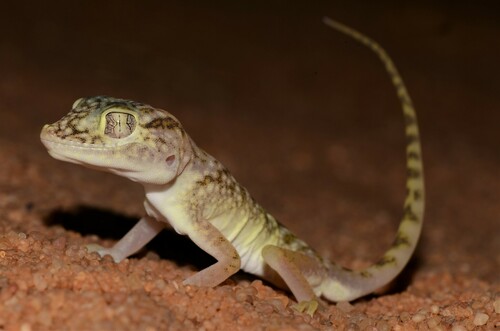
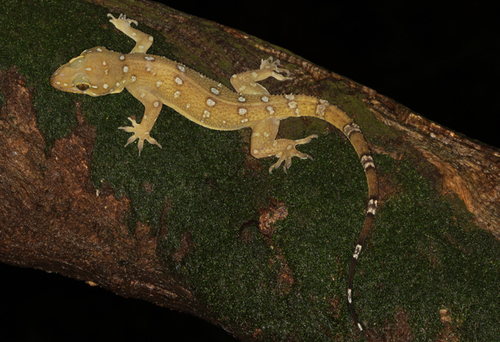
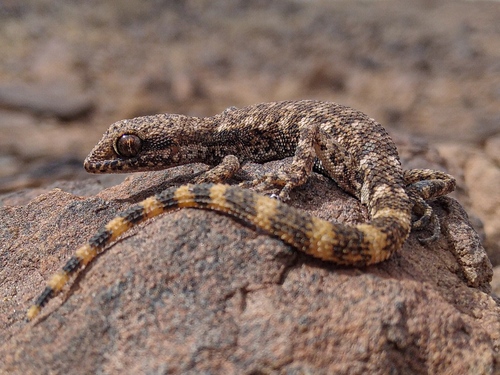
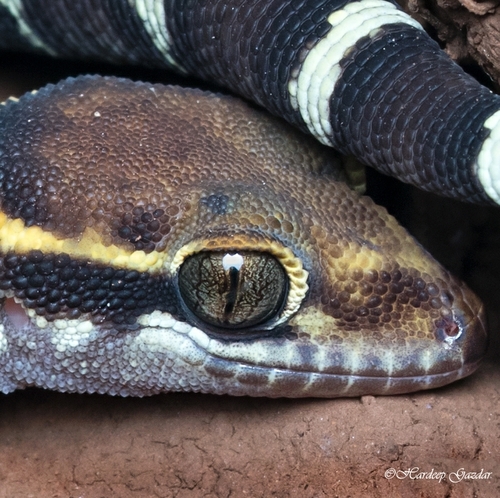
The species is reddish brown above, with narrow white, black-edged cross bars; the first bar is semicircular, extending from one eye to the other across the nape. There is a second bar on the scapular region, two on the body, and a fifth on the sacrum.
Ventral and Tail Coloration
Similar bands form annuli around the tail, and lower surfaces are whitish.
Size Measurements
From snout to vent the species measures 2.5 inches, and the tail measures 2.25 inches.
Type Locality
The type locality is "Deccan", Bombay Presidency.
Original Taxonomic Description
Günther originally described this species as Gymnodactylus (Geckoella) deccanensis in 1864, based on a single specimen collected in the Deccan.
Habitat and Diet
This is a nocturnal forest-dwelling species that lives on forest floors, is insectivorous, and is rarely encountered.
Distribution Range
It is common in the Northern Western Ghats, and has been reported in Sanjay Gandhi National Park, Matheran, Khandala, Phansad Wildlife Sanctuary, Tungareshwar Wildlife Sanctuary, Koyna Wildlife Sanctuary, and Tamhini Ghat. It has recently been reported from Saputara Hills, in the Dang District of Gujarat.
Taxonomic Note
Some taxonomic authorities still place this species in the genus Geckoella.