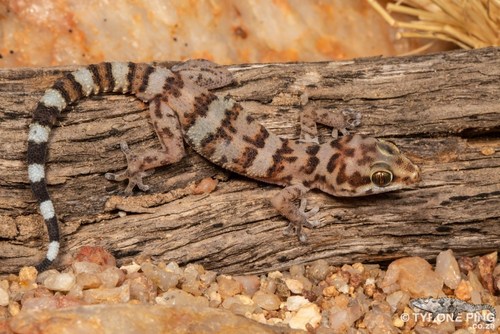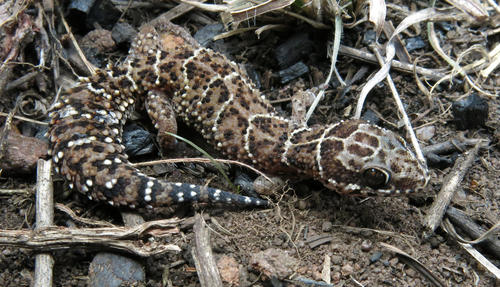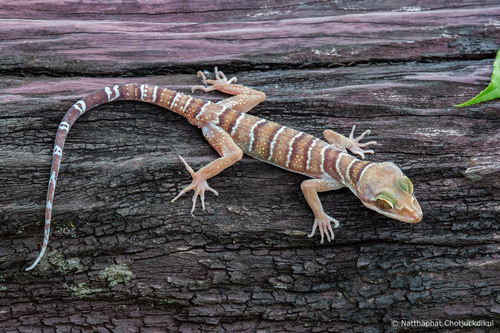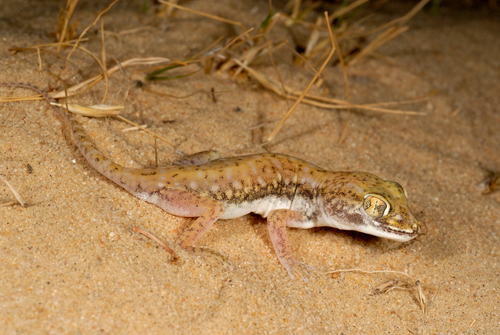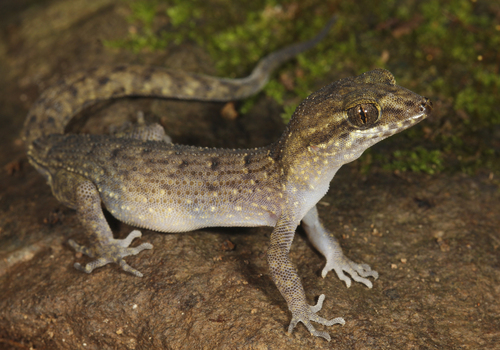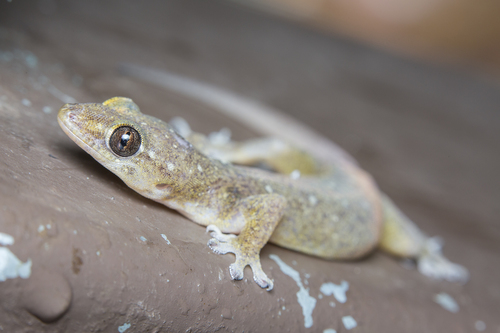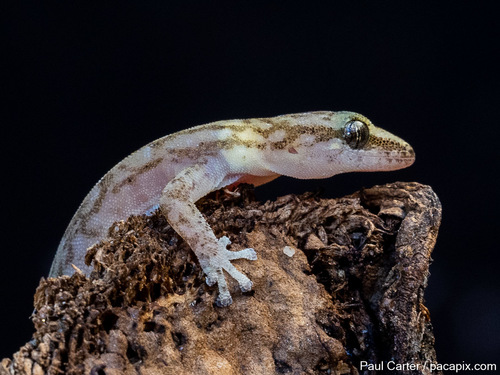
About Afrogecko porphyreus (Daudin, 1802)
Body Appearance
Afrogecko porphyreus has a mottled greyish body, a long tail, and sometimes a pale stripe running along its back.
Color Variation
Its coloration varies widely, ranging from almost black-and-buff patterning to smudged shades of buff.
Foraging & Sheltering Habits
It is a small adaptable forager that hides under debris, beneath bark, among rocks, and even inside city houses.
Pest Control Role
This gecko eats large quantities of small insects, so a population living on a property acts as a natural form of pest control.
Diet Composition
Its full diet includes a range of invertebrates, including feeder insects.
Predation by Cats
Domestic cats commonly kill large numbers of these small lizards, and sometimes eliminate entire local populations.
Predation by Spiders
They are also preyed on by spider species in the genus Palystes, which may be more effective predators of these geckos than cats are.
Defense Mechanism
Like many similar gecko species, one of Afrogecko porphyreus’s main defenses is tail autotomy.
Tail Regeneration Prevalence
In some populations, almost all mature individuals have either fully regenerated tails or tails that are currently in the process of regenerating.
Geographic Range
This gecko is commonly found in the southern parts of South Africa, ranging from Cape Town, where it now lives in suburban gardens, eastward to the Eastern Cape.
Territorial Behavior
A. porphyreus is not aggressive or territorial, and multiple individuals will often share a single retreat.
Nesting Behavior
These social lizards even share nests, where several females will lay their eggs together.