About Cyprinodon diabolis Wales, 1930
Size
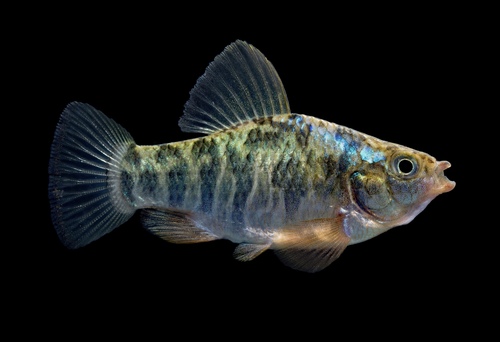
The Devils Hole pupfish (Cyprinodon diabolis Wales, 1930) is the smallest pupfish species in the genus Cyprinodon, reaching a maximum length of 30 mm (1.2 in) with an average length of 23 mm (0.9 in).
Sexual Dimorphism
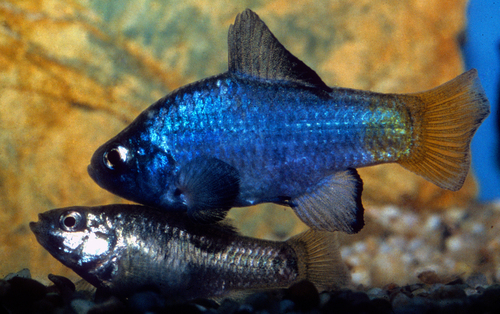
The species shows clear color differences between males and females.
Male Coloration
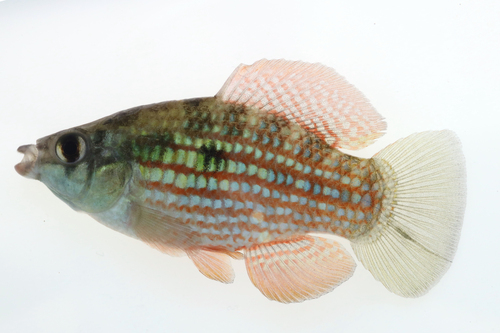
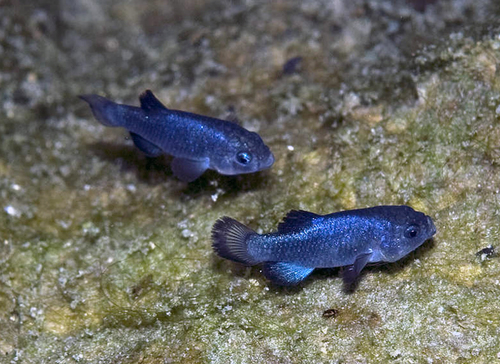
Males are overall dark brown with metallic blue sides, all fin margins are black, their backs have golden iridescence, and this iridescence is especially strong on the opercles (gill covers), which have a violet sheen on their posterior. Males also have a blue, iridescent iris.
Female Coloration
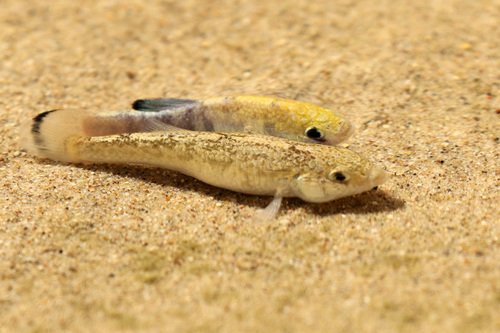
Females and young individuals are more yellow in color than males. Females have yellowish-brown backs; the margins of their pectoral and caudal fins are yellow rather than black, though their dorsal fin has a black margin just like males. Female opercles are metallic green, and their eyes are tinted metallic blue.
Juvenile Coloration
Young fish share the same general coloration as females, but have a faint vertical bar on their sides.
Pelvic Fin Trait
Devils Hole pupfish usually lack pelvic fins, though individuals raised in lower temperatures in captivity have been observed to grow these fins.
Fin Ray Count
This species has twelve dorsal fin rays, seventeen rays per pectoral fin, and a convex outward-curving caudal fin with twenty-eight rays.
Scale Characteristics
The lateral series (number of scales from the posterior end of the opercle to the start of the tail) counts twenty-seven scales, and the scales have toothed (ctenoid) outer margins.
Endemic Range
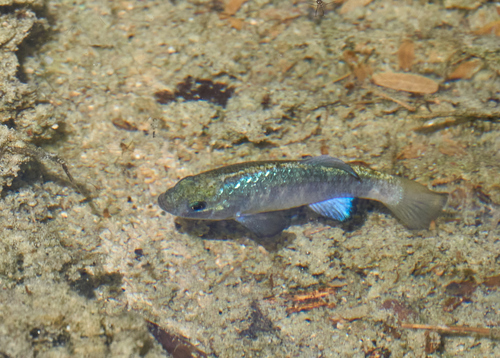
This species is endemic to Devils Hole, located in the Amargosa Desert ecosystem of Amargosa Valley, southwestern Nevada, United States, east of Death Valley, the Funeral Mountains, and the Amargosa Range.
Regional Hydrology
The Amargosa River is part of the regional aquifer hydrology connected to Devils Hole.
Devils Hole Physical Features
Devils Hole is a water-filled cavern extending into a hillside, sitting 730 m (2,400 ft) above sea level with a constant water temperature of 33 °C (91 °F). The open water surface of Devils Hole measures approximately 22 m long by 3.5 m wide (72 ft by 11.5 ft), and the cavern is at least 130 m (430 ft) deep.
Habitat Size Note
This habitat is noted as possibly the smallest in the world to support the entire population of a vertebrate species.
Shallow Shelf Dimensions
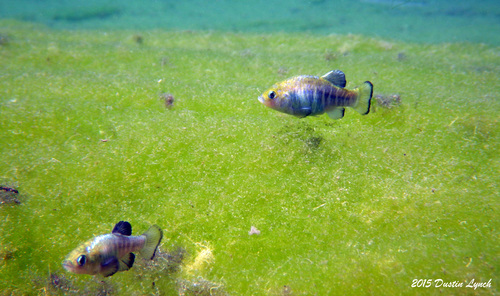
At one end of Devils Hole, a 3.5 by 5 m (11 by 16 ft) small shallow rock shelf sits in approximately 0.3 m (0.98 ft) of water.
Dissolved Oxygen Levels
Dissolved oxygen levels in the water measure 2.5–3.0 ppm down to roughly 22 m (72 ft) depth, while the shallow shelf can reach 6.0–7.0 ppm dissolved oxygen in June and July.
Depth Distribution
While pupfish have been recorded as deep as 24 metres (80 ft), their population is densest at depths shallower than 15 m (49 ft).
Shallow Shelf Function
The fish depend on this shallow shelf for spawning, and much of their diet (primarily made up of diatoms) comes from the area.
Threats
Natural threats including flash floods and earthquakes can disrupt this fragile ecosystem; in the 1960s and 1970s, the biggest threat was groundwater depletion caused by agricultural irrigation.
Population Drivers
Research shows the species' annual population fluctuation responds to the amount of algae growing on the shallow shelf, which in turn depends on incoming solar radiation and nutrient levels.
Nutrient Input Source
Nutrient availability tends to peak when barn owls roost or nest in the cave, as their nutrient-rich droppings (pellets) fall into the water.
Feeding Habit General
Devils Hole pupfish feed on a wide range of food items, making use of nearly all available food resources in Devils Hole.
Diet Components
Their recorded food resources include inorganic particulate matter, the algae Spirogyra, diatoms, freshwater crustaceans Hyalella azteca and ostracods, protozoa, the beetle Stenelmis calida, the flatworm Girardia dorotocephala, and freshwater snails of the genus Tryonia.
Seasonal Diet Shifts
Consumption of different resources shifts seasonally, though one study found inorganic particulate matter present in stomach contents at high frequency year-round.
Inorganic Matter Composition
This inorganic particulate matter is primarily made up of travertine, a form of limestone.
Seasonal Diet Breakdown
The three most frequently encountered food items by season are: Spring (March–May): inorganic particulate matter (83%), diatoms (75%), Spirogyra (58%); Summer (June–August): inorganic particulate matter (79%), Spirogyra (46%), diatoms (46%); Autumn (September–November): inorganic particulate matter (95%), Spirogyra (74%), Hyalella azteca (33%); Winter (December–February): inorganic particulate matter (100%), diatoms (91%), ostracods (45%).
Spirogyra Role
Since Spirogyra is mostly found undigested in stomachs, researchers hypothesize it is not an important food source, but instead acts as a foraging substrate.
Inorganic Matter Consumption Cause
Inorganic particulate matter is thought to be consumed incidentally, as a result of the fish's foraging strategy of feeding on both the bottom and surface of the water.
Predator and Competitor
The main predator of Devils Hole pupfish is the diving beetle Neoclypeodytes cinctellus, which feeds on the fish's eggs and juveniles. This beetle also shares many of the same invertebrate prey as the pupfish, so it acts as both a predator and a competitor.
Beetle Arrival Timeline
N. cinctellus is a recent addition to the Devils Hole ecosystem, first documented there in 1999 or 2000.
Spawning Periods
Devils Hole pupfish spawn year-round, with a main spawning peak from mid-February to mid-May, and a smaller secondary peak from July to September.
Fecundity
Females have very low fecundity: the average female only produces four or five mature ova (egg cells) per breeding season, and mature ova make up just 10–20% of a female's total ova count.
Egg Characteristics
Each spawn is thought to produce only a single egg, which measures just 1 mm (0.039 in) in diameter.
Survival Rate Traits
In addition to low fecundity, the species has low egg hatching success and low juvenile survival rates.
Lifespan
Individual Devils Hole pupfish have a lifespan of 10–14 months.
Earthquake Response Behavior
Because the rock shelf the fish use for feeding and breeding is vulnerable to seismic activity, the species has specialized behavior to reduce earthquake impacts. When a disturbance like an earthquake occurs, all fish flee en masse to deeper water, then trigger an out-of-season spawning event.
Disturbance Spawning Process
During this disturbance-induced spawning, multiple males chase a single female until she becomes receptive; the female then allows one male to swim alongside her, lays an egg, and the male fertilizes it immediately.
Movement Patterns General
The species follows daily and seasonal movement patterns within Devils Hole.
Midday Shelf Use
Around midday, when sunlight on the shallow shelf is most intense, fewer fish are present on the shelf. This midday departure is most pronounced from April through September.
Winter Shelf Use
From December to March, when the shallow shelf receives little to no direct midday sunlight, fish numbers on the shelf increase as the day goes on.
Summer Shelf Use
In summer, when the shelf receives the most sunlight, fish are less likely to use the shallow shelf overall.
Anaerobic Adaptation
As an adaptation to the habitat's naturally low oxygen saturation, Devils Hole pupfish exhibit a behavior called "paradoxical anaerobism". The fish enter a state of torpor and can go without breathing oxygen for up to two hours. This alternate respiration method produces ethanol as a byproduct.