About Cynomys ludovicianus (Ord, 1815)
Pelage Coloration
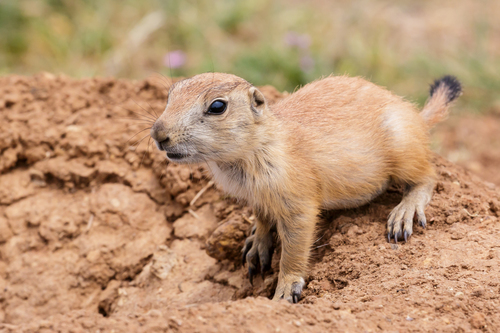
Black-tailed prairie dogs (Cynomys ludovicianus (Ord, 1815)) are generally tan with lighter-colored bellies. Their pelt can show color variation, with dark black and brown fur often present on their backs. Their tails have black tips, which gives the species its common name.
Adult Weight
Adult weights range from 1.5 to 3.0 lb (0.68 to 1.36 kg), and males are typically heavier than females.
Body Length Measurements
Total body length normally ranges from 14 to 17 in (36 to 43 cm), with a tail that measures 3 to 4 inches (7.6 to 10.2 cm).
Digging Adaptations
Black-tailed prairie dogs have long black claws adapted for digging in the ground.
Body and Ear Morphology
They have a compact body, and quite small ears that sit close to the head.
General Habitat Types
Black-tailed prairie dogs inhabit grasslands, including short- and mixed-grass prairie, sagebrush steppe, and desert grasslands.
Preferred Prairie Vegetation
Their preferred habitat includes shortgrass prairies dominated by buffalo grass (Buchloe dactyloides), blue grama (Bouteloua gracilis), and western wheatgrass (Pascopyron smithii), plus mixed-grass prairies that have been grazed by native and non-native herbivores.
Optimal Habitat Slope and Vegetation Height
Slopes between 2% and 5% and vegetation heights between 3 and 5 in (8 and 13 cm) are optimal for detecting predators and facilitating communication.
Great Plains Colony Location
In the Great Plains region, black-tailed prairie dog colonies commonly occur near rivers and creeks.
South Dakota Colony Site Types
Out of 86 colonies located in Mellette County, South Dakota, 30 were located on benches or terraces adjacent to a creek or floodplain, 30 occurred in rolling hills with a slope more than 5°, 20 were in flat areas, and six were in badland areas.
Texas Panhandle Habitat Use
The slopes of playa lakes in the Texas Panhandle and surrounding regions are used as habitat for this species.
Montana Colony Human-Associated Sites
Colonies in Phillips County, Montana, were often associated with reservoirs, cattle salting grounds, and other areas affected by humans.
Disturbance Tolerance
Black-tailed prairie dogs tolerate high degrees of disturbance over long periods of time.
Rangeland Colonization Patterns
New colonies are rarely created on rangeland in good to excellent condition; however, continuous long-term heavy grazing reduces habitat quality due to soil erosion. Black-tailed prairie dogs may colonize heavily grazed sites, but do not necessarily specialize in colonizing overgrazed areas. Overgrazing may occur after they have colonized an area.
Montana Grazed and Disturbed Habitat Associations
In sagebrush-grassland habitat on the Charles M. Russell National Wildlife Refuge and Fort Belknap Agency, Montana, black-tailed prairie dogs were associated with areas intensively grazed by livestock and/or areas where topsoil had been disturbed by human activities.
Colony Proximity to Human and Livestock Features
Roads and cattle trails were found in 150 of 154 studied black-tailed prairie dog colonies, and colonies were located significantly closer to livestock water developments and homestead sites than randomly placed points.
Native Range Continent
Black-tailed prairie dogs are native to North American grassland habitats.
Occupied Habitat Types
They inhabit shortgrass prairie, mixed-grass prairie, sagebrush steppe, and desert grassland.
Habitat Preference Drivers
Their habitat preferences are influenced by vegetative cover type, slope, soil type, and amount of rainfall.
Ecosystem Engineering Effects
Their foraging and burrowing activities influence environmental heterogeneity, hydrology, nutrient cycling, biodiversity, landscape architecture, and plant succession in grassland habitats.
Historic Range Extent
The historic range of the black-tailed prairie dog stretched from southern Saskatchewan and Alberta to Chihuahua, Mexico, and included portions of Montana, North Dakota, South Dakota, Wyoming, Colorado, Nebraska, Kansas, Oklahoma, Texas, Arizona, and New Mexico.
2007 Current Range Status
As of 2007, black-tailed prairie dogs occur across most of their historic range, excluding Arizona; however, their total occupied acreage and population sizes are well below historic levels.
Coterie Territory Size
The home range and territorial boundaries of black-tailed prairie dogs are determined by the area occupied by an individual coterie. Coteries typically occupy about 1 acre (0.40 ha).
Population Density Drivers
Population density and growth are influenced by habitat quality, and are restricted by topographic barriers, soil structure, tall vegetation, and social conditions.
Colony Size Restriction Factors
Urbanization and other types of human development may restrict colony size and spatial distribution.
Typical Plains Population Density
Most plains habitats support at least 13 black-tailed prairie dogs per hectare.
Reproductive Parameter Drivers
For the black-tailed prairie dog, age of first reproduction, pregnancy rate, litter size, juvenile growth rate, and first-year survival all vary depending on food availability.