About Cymbalaria muralis G.Gaertn., B.Mey. & Scherb.
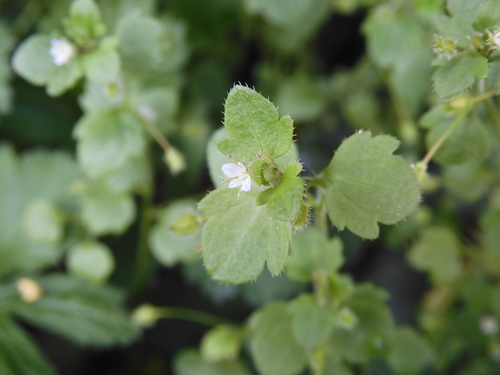
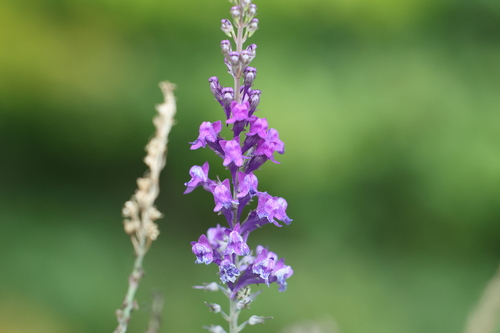
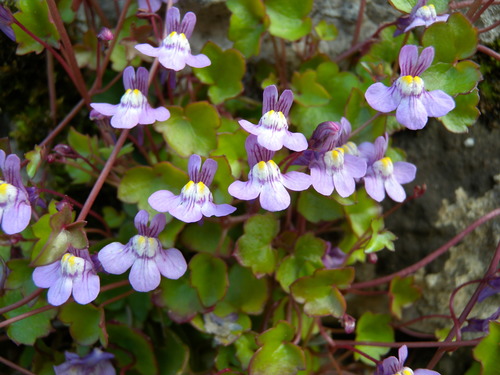
Cymbalaria muralis G.Gaertn., B.Mey. & Scherb. spreads quickly and grows 10–80 cm (3.9–31.5 in) tall. It is a biennial or short-lived perennial plant. It has thin, fibrous roots that grow into cracks. Its leaves are rounded, heart-shaped, or kidney-shaped, 5–40 mm long and 6–60 mm wide. Leaves are arranged alternately, held on thin, usually purple petioles that are 10–22 mm long. For the nominate subspecies (Cymbalaria muralis subsp. muralis), leaves are either smooth (glabrous) or have widely scattered hairs; for subspecies visianii, leaves are covered in soft, fine hairs (pubescent/villous). Leaves usually have 3 to 7 lobes, most often 5 lobes. They are relatively thick, and their undersides are often tinted purple. Cymbalaria muralis produces small flowers that strongly resemble snapdragon flowers. At the base of each flower are sepals with sharply pointed lobes 1.5–3 mm long. Petals form a closed tube 3–5 mm long. Like snapdragons, the lower lip of the flower expands upward to block the flower tube, with an inflated palate. The two cushion-shaped sections of the lip under the flower mouth have yellow spots. The flower's lower lobes spread outward, while the upper lobes stand upright; all lobes have rounded ends and are 2–3 mm long. Most flowers are lilac with a yellow throat and darker lines on the upper lobes; rarely, flowers are all or almost all white. A short spur sits at the back of the flower, measuring about one third of the flower's total length. Flowering times depend on local conditions. It may flower from May to November in Britain, from June to July (with seeds ripening in September) in Eastern Europe, from May to October in North America, and year-round from January to December in New Zealand. Flowers are pollinated by bees, and are also self-compatible. After fertilization, the plant forms a globular seed capsule 3–5 mm in diameter. Each capsule has two openings, each with three valves. Seeds are very small, 0.5–1 mm long, crescent-shaped, and covered in tiny warty bumps. This species has an unusual method of self-seeding. The flower stalk is initially positively phototropic and grows toward light. After fertilization, it becomes negatively phototropic (scototropic) and moves away from light. This pushes seed capsules into dark crevices in rock walls, where germination is more likely. According to Plants of the World Online (POWO), the native range of this species is limited to southern Europe, specifically Austria, France, Italy, Switzerland, and the former Yugoslavia. The nominate subspecies Cymbalaria muralis subsp. muralis occurs throughout this entire native range. The World Plants database also records the species as native to this same general area, more specifically Slovenia, Croatia, Bosnia & Hercegovina, Serbia, and Kosovo in the former Yugoslavia, plus the small state of San Marino on the Italian peninsula. The World Plants database also lists the species as native to additional areas northeast of the Alps including Czechia, Slovakia, and Liechtenstein, as well as many Atlantic islands: the Azores, Madeira, the Canary Islands, and the Cape Verde Islands. POWO records Cymbalaria muralis subsp. visianii as growing in the southeastern portion of the species' range, only in Italy and the former Yugoslavia. The World Plants database largely agrees, listing this subspecies as native to central and southern Italy and Croatia, and also notes it has been introduced to Germany. This subspecies has also been recorded as naturalized in Britain since 1970. From its original native range, the species has spread to most of Europe and much of the rest of the world, both as an accidental introduction and as a result of its use as an ornamental plant. The first record of this species growing outside cultivation in Great Britain dates to 1640. A commonly repeated story claims the plant was accidentally introduced with a shipment of statuary to Oxford, but this is unlikely, as it was recorded growing in an English garden in Droxford as early as 1617. After this introduction, it became a popular ornamental plant widely planted across the United Kingdom through the 19th century. It can now be found from Ireland and Portugal in the west, eastward through every country as far as Ukraine, Poland, and Sweden. According to POWO, it may also occur in the Baltic States, northwestern Russia, and the North Caucasus, while the World Plants database records it in Belarus and Georgia. In Africa, it grows in Morocco, Algeria, and Tunisia in North Africa, and in the Cape Provinces and Northern Provinces floristic regions of South Africa. In Asia, it is now found in Turkey, Jordan, North Korea, South Korea, and the eastern Himalayas. In North America, it has been recorded growing outside cultivation in Bermuda, Canada, Costa Rica, Guatemala, Honduras, Jamaica, Mexico, and the United States. In the United States, it is agreed to grow across much of the Midwest, northeast, and New England, as far south as South Carolina, Tennessee, and Arkansas, and as far west as Wisconsin, Illinois, and Missouri, with the exception of Maine and New Hampshire. It is also found on the west coast in California, Oregon, and Washington State. It occurs more scatteringly in interior states, where it is listed as growing in Colorado, Nebraska, South Dakota, and Utah; Utah is recorded by the USDA Natural Resources Conservation Service PLANTS database (PLANTS) and World Plants, but not by POWO. In Canada, all sources agree it grows in five provinces: British Columbia, Manitoba, New Brunswick, Ontario, and Québec. PLANTS and World Plants also record it in Nova Scotia, while only POWO records it on the island of Newfoundland. In South America, it has been observed in northern South America in Colombia, Ecuador, and Peru. It has also been recorded in southern and southeastern Brazil, Uruguay, Bolivia, and northern Argentina. In mainland Chile, it has been reported from Valparaíso, Santiago, the Maule Region, and the Biobío Region. On oceanic islands, it has been introduced to Maui in Hawaii, both the North and South Islands of New Zealand, Bermuda, Mauritius, St. Helena, and the Juan Fernández Islands. It is also found in six Australian states: Western Australia, South Australia, Victoria, New South Wales, southern Queensland, and the island state of Tasmania. The original habitat of Cymbalaria muralis consists of narrow niches in rock faces and cliffs. In cooler climates such as Lower Silesia in Poland, it grows in warm microclimates, for example on south- or west-facing structure walls or river embankments. It is considered a very characteristic species of vegetation that grows on walls. In hot climates, it becomes a high altitude specialist; for example, it grows at 1100–1300 m in elevation in Costa Rica. Cymbalaria muralis is a generalist that attracts a wide range of pollinators, including bees, flies, and butterflies. Its roots form associations with arbuscular mycorrhiza, a group of fungi that form symbiotic partnerships with plants. At least three aphid species are commonly found on this plant: Myzus ornatus (violet aphid), Myzus persicae (green peach aphid), and Myzus cymbalariae. Myzus cymbalariae was first observed feeding on ivy-leaved toadflax, and is named for this species. The plant also acts as a host for tomato ringspot virus. In cultivation, ivy-leaved toadflax is planted as a groundcover, particularly on rocky slopes, and is placed into wall cracks. Once established, it reproduces on its own, both through self-seeding and through rooting of its stems. It is winter hardy in USDA zones 5 to 9. According to garden author Carolyn Singer, it is deer resistant.