About Veronica hederifolia L.
Scientific Identity and Growth Form
Veronica hederifolia L. is an annual herb with procumbent to climbing stems that grow up to 60 centimetres (24 inches) long.
Stem Characteristics
Its stems are green to purplish in color, round in shape, and covered in abundant spreading, wavy hairs 1 mm long, with these hairs forming a thick line along one side of the stem.
Leaf Arrangement
Its leaves are arranged oppositely along the lower stem, becoming alternate higher up the stem; each leaf has a 4–15 mm long petiole and no stipules.
Leaf Morphology
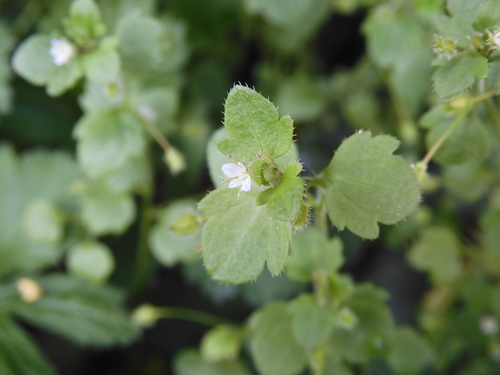
Leaf blades are shallowly divided into 5 ivy-like lobes (sometimes 3–7 lobes or undivided), are darker on the upper surface than the lower surface, grow up to 1.5 cm long, and are downy on both surfaces, with long hairs along the margins.
Flower Placement
Flowers grow singly in leaf axils, on pedicels up to 18 mm long.
Calyx Structure
The calyx has four triangular lobes that expand after flowering.
Petal Characteristics
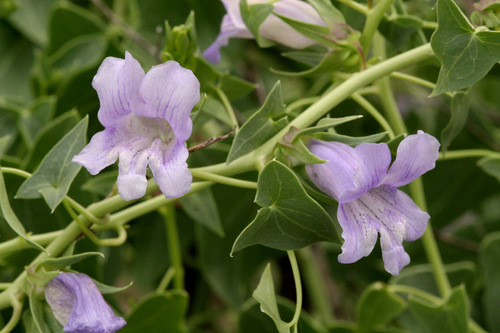
There are 4–5 pale lilac petals, each 2 mm long, marked with darker veins.
Reproductive Flower Parts
The flower has 2 stamens with blue anthers, and one style.
Fruit Structure
The fruit is a glabrous capsule, typically 2-celled, and occasionally 1–3-celled.
Global Distribution
This species is thought to be native to southern Europe, and is widely naturalized outside its native range, including in northern Europe as far north as Scandinavia, the United States, Japan, Australia, New Zealand, and scattered locations elsewhere.
Distribution in Britain
In Britain, it is ubiquitous across all lowland areas, and only becomes rare in the mountains of Cumbria and the Highlands and Islands of Scotland.
Distribution in Ireland
In Ireland, it has a similar southeastern distribution, becoming less common toward the west.
British Habitat Types
In Britain, Veronica hederifolia L. is mainly associated with inhabited areas, and is common in towns and villages, where it grows in gardens, hedges, roadsides and on waste ground. It is also found less commonly in arable fields and more undisturbed wild places.
Altitude Range
It is a strictly lowland plant; the maximum recorded altitude for the species is 380 m at Malham Moor in Yorkshire, a record dating back to 1888, so this may have been an atypical occurrence.