About Cyclopsitta diophthalma (Hombron & Jacquinot, 1841)
Nomenclature
The double-eyed fig parrot, scientifically named Cyclopsitta diophthalma, has several other common names: blue-faced fig parrot, red-faced fig parrot, dwarf fig parrot, and two-eyed fig parrot.
Distribution
This species primarily lives in forests on New Guinea and its surrounding nearby islands, and also occurs in isolated populations along tropical Australian coasts east of the Great Dividing Range.
Size
With an average total length of around 14 cm (5+1⁄2 inches), it is the smallest parrot found in Australia.
Sexual Dimorphism
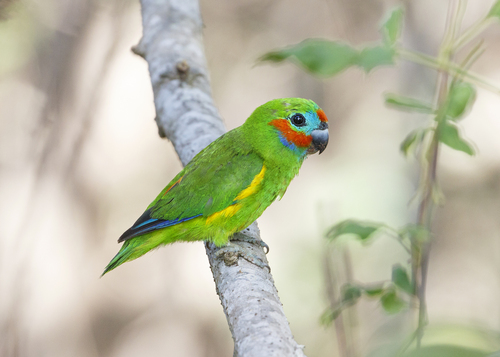
Most subspecies of the double-eyed fig parrot are sexually dimorphic: males have more red coloring (and less silvery and blue coloring) on their faces than females.
Physical Appearance
The parrot is predominantly green, with a very short tail, a disproportionately large head and bill, and red and blue markings on its face.
Etymology
Its common name comes from a blue spot on the lores, which is roughly the same size as the eye in New Guinean populations of the species.
Global Conservation Status
While the IUCN has assessed the whole species as Least Concern, some of its specific subspecies are currently under threat.
Coxen's Fig Parrot Status
Coxen's fig parrot, the subspecies C. d. coxeni, is one of the rarest and least studied birds in Australia. It has been recorded fewer than 200 times since it was first described by Gould in 1866.
Subspecies Legal Protection
This subspecies is classified as Endangered under Queensland's Nature Conservation Act 1992, New South Wales' Threatened Species Conservation Act 1995, and Australia's national Environment Protection and Biodiversity Conservation Act 1999.
Threats
Its population has declined at least partially due to the clearing of lowland subtropical rainforest across its range.