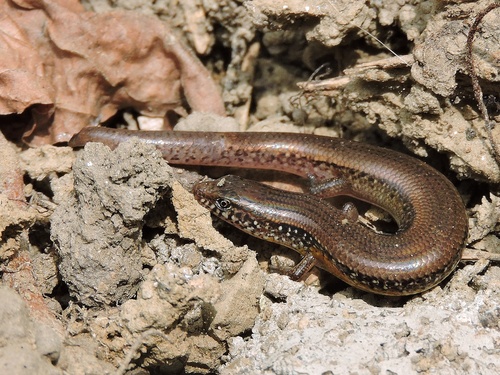
About Cyclodomorphus gerrardii (Gray, 1845)
Size
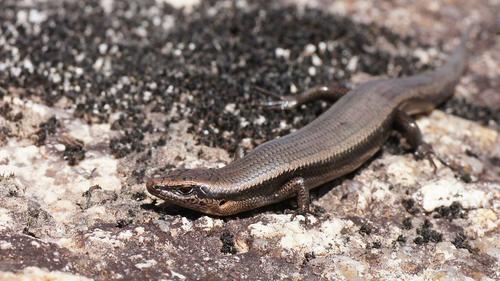
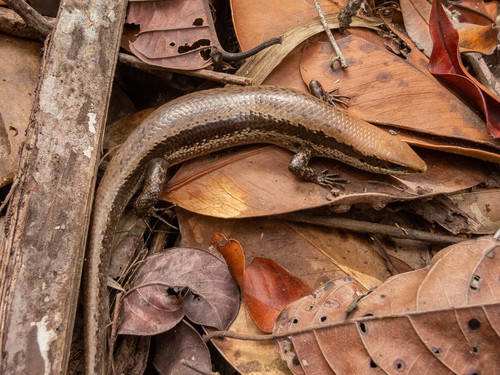
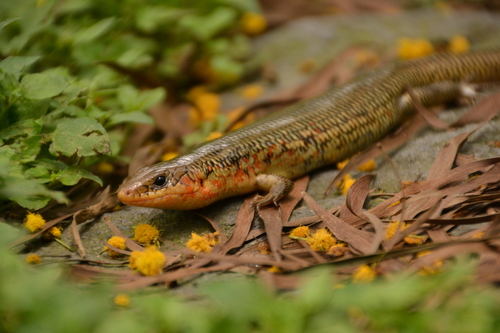
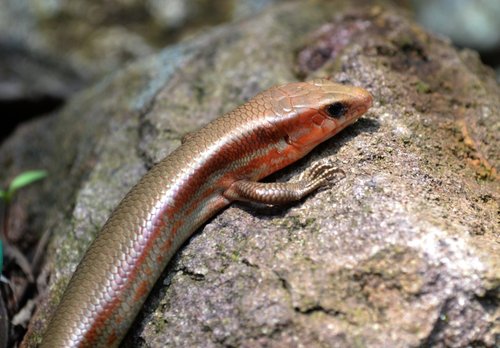
Cyclodomorphus gerrardii is a relatively large lizard that reaches a total maximum length of 45 cm (18 in), including the tail.
Body and Tail Shape
It has a slender build with a long, slender, slightly prehensile tail that is roughly the same length as its body. Its limbs are well developed, with long digits and sharp claws.
Head and Neck Features
It has a clearly defined neck, and a relatively large head that is wider in males than in females. Adult individuals have a pink tongue.
Adult Dorsal Coloration
The dorsal base color of C. gerrardii ranges from slate-grey to fawn, marked with dark grey, brown, or black cross bands. These bands are more distinct in males and less noticeable in females.
Cross Band Characteristics
There are approximately 20 cross bands running from the neck to the tip of the tail, which angle slightly backward along the sides.
Ventral Coloration
The underside of the lizard ranges from white to pinkish or creamy brown, and may have a marbled pattern over the cross bands.
Scale Features
Its scales are smooth; scales on the head have darker edges.
Adult Head and Limb Markings
Adult individuals have a dark snout tip, with some additional dark spotting on the head. The limbs have dark spots or streaks.
Juvenile Coloration
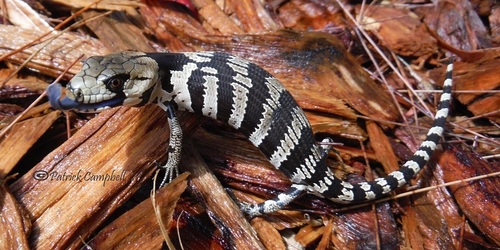
All juvenile C. gerrardii have distinct black cross bands over a very light grey base color. They have multiple dark spots on the head, particularly under the eyes.
Juvenile Traits
Juveniles have a light-colored snout tip, and both their tongue and mouth are blue.
Taxonomic History
Due to their close relationship, C. gerrardii has historically been classified in both the genus Tiliqua and the genus Cyclodomorphus, with previous valid names including both Cyclodomorphus gerrardii and Tiliqua gerrardii (per Cogger 2000).
Similarity to Tiliqua scincoides
It is very similar in appearance to the eastern blue-tongue, Tiliqua scincoides, but unlike that species, adult C. gerrardii have a pink tongue, matching its common name. C. gerrardii is also much more slender than T. scincoides, with a more slender body, a much longer and narrower tail, and a smaller head.
Limb Comparison to Blue-tongues
Additionally, its limbs are more developed and longer than the limbs of blue-tongue lizards.
Distribution
C. gerrardii is endemic to Australia, where it ranges from Springwood, New South Wales, along eastern coastal lands and the eastern mountain ranges north to the Cairns Region, Queensland.
Habitat Types
This species inhabits wet sclerophyll forests, rainforests, and moist areas within woodlands.
Shelter Sites
It shelters under leaf litter, inside hollow logs, and in rock and tree crevices.
Morphological Adaptation for Movement
Its slender body and limbs are an adaptation for moving through thick undergrowth.
Locomotion
On smooth surfaces, C. gerrardii moves via lateral undulations; when moving through grass and climbing on branches, it holds its hind limbs close to its body, moves its tail in a side-winding motion, and uses only its forelimbs.
Diet
Its diet consists mainly of snails and slugs.
Foraging Period
It forages for this prey during twilight hours and at night in summer, and also forages during the day in cooler months.
Feeding Adaptation
To crush snail shells, C. gerrardii uses large, flattened teeth located at the back of its upper and lower jaws.
Climbing Ability
C. gerrardii is a skilled climber that uses its semi-prehensile tail for support. It is only partially arboreal, but will climb trees to feed when needed.
Juvenile Climbing Behavior
Juveniles appear to climb vegetation more often to escape predators.
Anti-predator Behavior
When threatened, C. gerrardii lifts its body off the ground to appear larger, and flicks or vibrates its tongue rapidly in a motion similar to that of snakes.