About Crepis sancta (L.) Bornm.
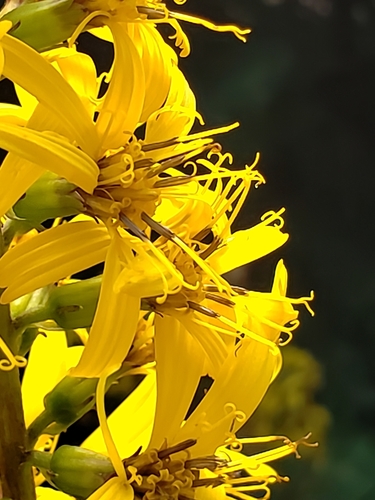
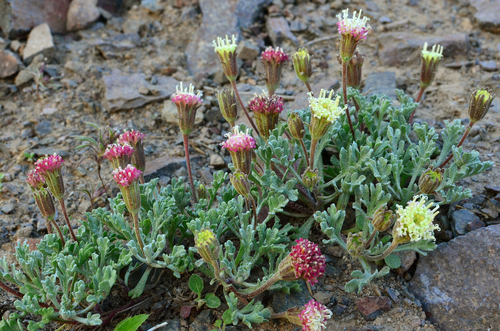
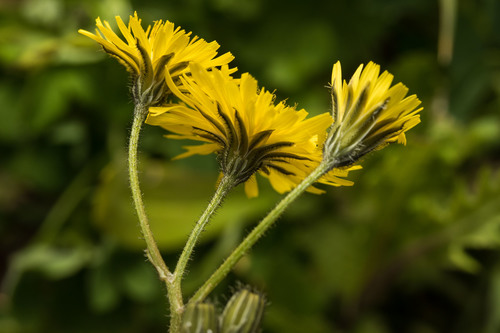
Crepis sancta (L.) Bornm. is an annual rosette herb, 3 - 55 (up to 85) cm high. Its flowering stems are scapelike, either erect or spreading - erect, sulcate, subglabrous or glandular. They can be unbranched with a single head or branched near the apex. Rosette leaves vary, often obovate, 1.0 - 20.0 cm long and 0.5 - 4.0 cm wide, with lyrate - pinnatisect, pinnatifid or runcinate shapes, dentate or subentire margins, and are either shortly acute, rounded or obtuse. They are petiole - like attenuate, glabrous or thinly hispidulous, especially along the midrib and nerves. Cauline leaves are few or absent, reduced to scales. The synflorescence usually has 1 head or up to 5 heads. The peduncle is 2.0 - 12.0 cm long, glandular or glabrous. Each head contains (14) - 30 - 60 (up to 100) flowers. The involucre is cylindrical or campanulate at flowering, 4.0 - 10.0 (up to 12.0) mm long and 2.5 - 7.0 mm in diameter at flowering, and strongly reflexed at fruiting. Outer involucral bracts are linear to ovate, 2.0 - 3.0 mm long and about 1.5 mm wide, subglabrous or thinly glandular with a scarious margin. Inner involucral bracts are linear, subacute, glandular or sometimes glabrous with a scarious margin. The receptacle is flat and has scales. The corolla is ligulate, 10 - 13 mm long and yellow. The tube is about 2.0 mm long, woolly at the apex, and the ligule is about 6.0 mm long, 1.0 - 1.2 mm wide, sometimes tinged red. The anther tube is yellowish, about 3.0 mm long. The style is about 8.0 mm long, greenish or yellow, with branches 1.0 - 1.5 mm long. Achenes can be dimorphic, sometimes trimorphic, or homomorphic. Outer achenes are cylindrical, 3.0 - 5.0 mm long and 0.6 - 1.5 mm wide, sulcate or smooth dorsally and mostly winged, stramineous or white, truncate, and may or may not have a pappus. Inner achenes are narrowly fusiform, 3.0 - 4.0 mm long and about 0.4 mm wide, sometimes scabridulous, brown or greenish, and truncate. The pappus is white, up to about 5.0 mm long, and scabridulous. Based on: Babcock, E. B. 1947: The genus <i>Crepis</i> 2. – Univ. Calif. Publ. Bot. 22; Lamond, J. M. 1975: 129. <i>Crepis</i> L. – Pp. 814 - 696. in: Davis, P. H. et al (ed.), Flora of Turkey 5 – Edinburgh; Meikle, R.D. 1985: Flora auf Cyprus 2. – Kew.