About Cotula coronopifolia L.
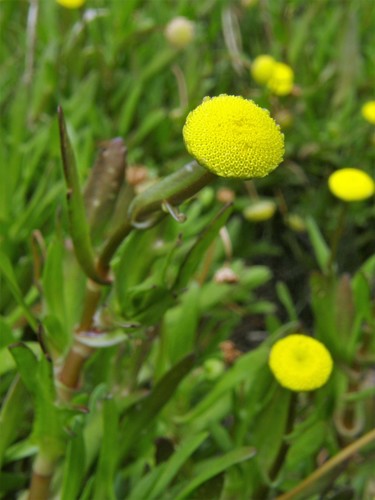
This species, commonly called brass buttons, has the scientific name Cotula coronopifolia L. Its flower heads are bright yellow, discoid, and shaped like thick buttons. Individual plants grow stems that spread along the ground, producing knobby flowers at intervals along these stems. It is native to southern Africa and New Zealand, and has been introduced to other regions across the globe, including Europe, North America, and South America. Brass buttons is a common plant that occupies a specialized ecological niche. It prefers muddy, anoxic wetlands and brackish water, and is very salt-tolerant. It has thick, fleshy leaves that store water during periods of saline inundation. Its reddish stems and green blade-shaped leaves are covered in a shiny cuticle to hold moisture. It can also grow in wetter patches of vernal pool ecosystems. This plant is common along beaches, salt marshes, and estuaries ranging from California to Washington in the United States. It has been present in the British Isles since the late 1800s, growing especially on the Cheshire coast, and is classified as a naturalized neophyte plant. While brass buttons is recognized as an invasive species, its spread is relatively slow. The California Invasive Plant Council rates it as "limited", meaning it is invasive but has only minor ecological impacts statewide, or there is insufficient data to justify a higher rating. Its reproductive biology and other traits give it low to moderate invasiveness, and its ecological range and distribution are generally limited, though it may be persistent and problematic locally.