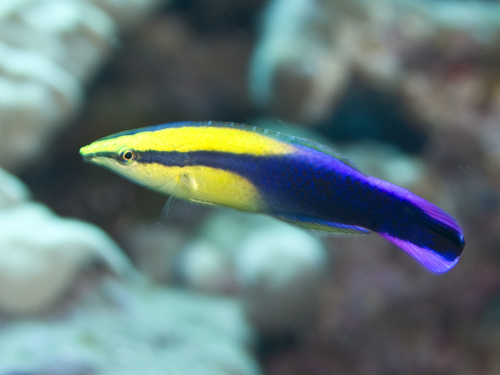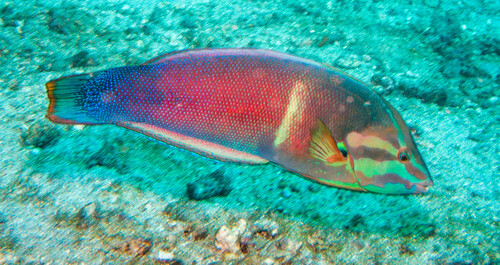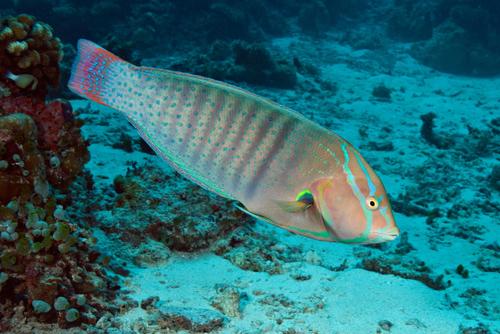
About Coris formosa (Bennett, 1830)
Common Name and Similar Species
Coris formosa, commonly called queen coris, is similar in appearance to Coris gaimard.
Size
Juveniles measure around 20 cm (7.9 in), while adults can grow to approximately 60 cm (24 in).
General Coloration Patterns
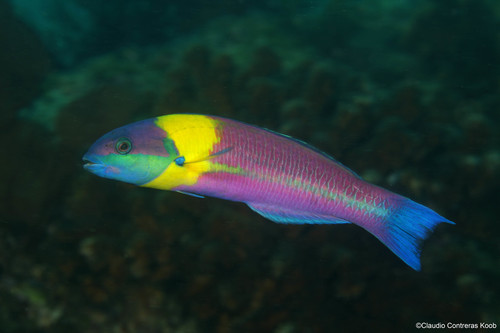
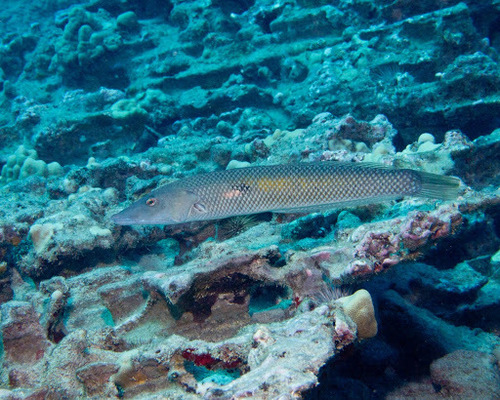
Its coloration follows three main patterns, and is typically a vivid reddish to lavender.
Adult Body Coloration
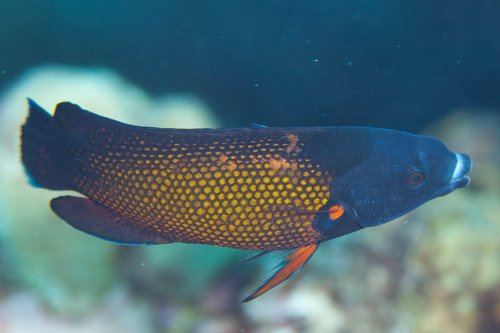
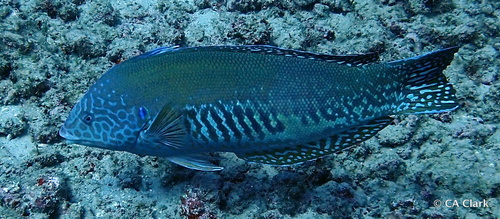
Adult Coris formosa have a blue-green body with dark edges and dark blue spots that are most concentrated toward the tail, plus a red-orange line on the posterior margin near the tail.
Adult Snout Coloration
Adults also have bright light blue curved lines near their snout.
Fin Structure
This fish has nine dorsal spines, twelve dorsal soft rays, and three anal spines.
Juvenile Coloration
Juvenile Coris formosa are orange with brown undersides and long white spots along the dorsal part of the body, and their coloration resembles that of clownfish.
Ontogenetic Color Change
Vibrant blue coloration develops as the fish reaches adulthood.
Sources of Color Variation
Color variation has been hypothesized to correlate with depth, but the main source of variation is the difference between juvenile and adult growth stages.
Color Function
Color is an important display trait for Coris formosa: it is used to attract potential mates and during aggressive interactions between males.
Feeding Morphology and Diet
This species has small protruding teeth that it uses to feed mostly on hard-shelled organisms.
Adult Habitat and Depth Range
Adult Coris formosa live on neritic coral reefs at depths between 2 m (6.6 ft) and 50 m (164.0 ft), in tropical waters with temperatures ranging from 24 °C to 27 °C.
Juvenile and Adult Microhabitat
Juveniles are most commonly found in tide pools, while adults typically occupy rocky and coral areas, sometimes in aquatic vegetation.
Geographical Distribution
This species is distributed across the Western Indian Ocean, from the Southern Red Sea and South Africa eastward to Sri Lanka.
Reproductive Mode
Like most fish, queen coris is oviparous, producing offspring from eggs.
Sexual System
It is a protogynous semi-hermaphrodite, meaning individuals can change sex from female to male.
Sex Development Pattern
In this species, female reproductive organs develop first, and most populations are primarily female.
Sex Transition Trigger
When a male is required for reproduction, one mature female will transition to male.
Breeding Mating System
Queen coris engage in polygamy and form distinct pairings during breeding.
Male Territoriality
Even though this is a solitary species, dominant males control a large female harem, or multiple harems, especially during the breeding season.
Hypothesized Courtship Behavior
It is hypothesized that males pursue females by swimming alongside them while fluttering their fins.